archive by month
Skip to content

Stone now attacks buildings

Igor Dimitrijevic has uploaded a new version of Stone, a version which attacks buildings instead of workers. I guess it’s because worker defense has been steadily improving, but many bots still don’t react when a building comes under attack.

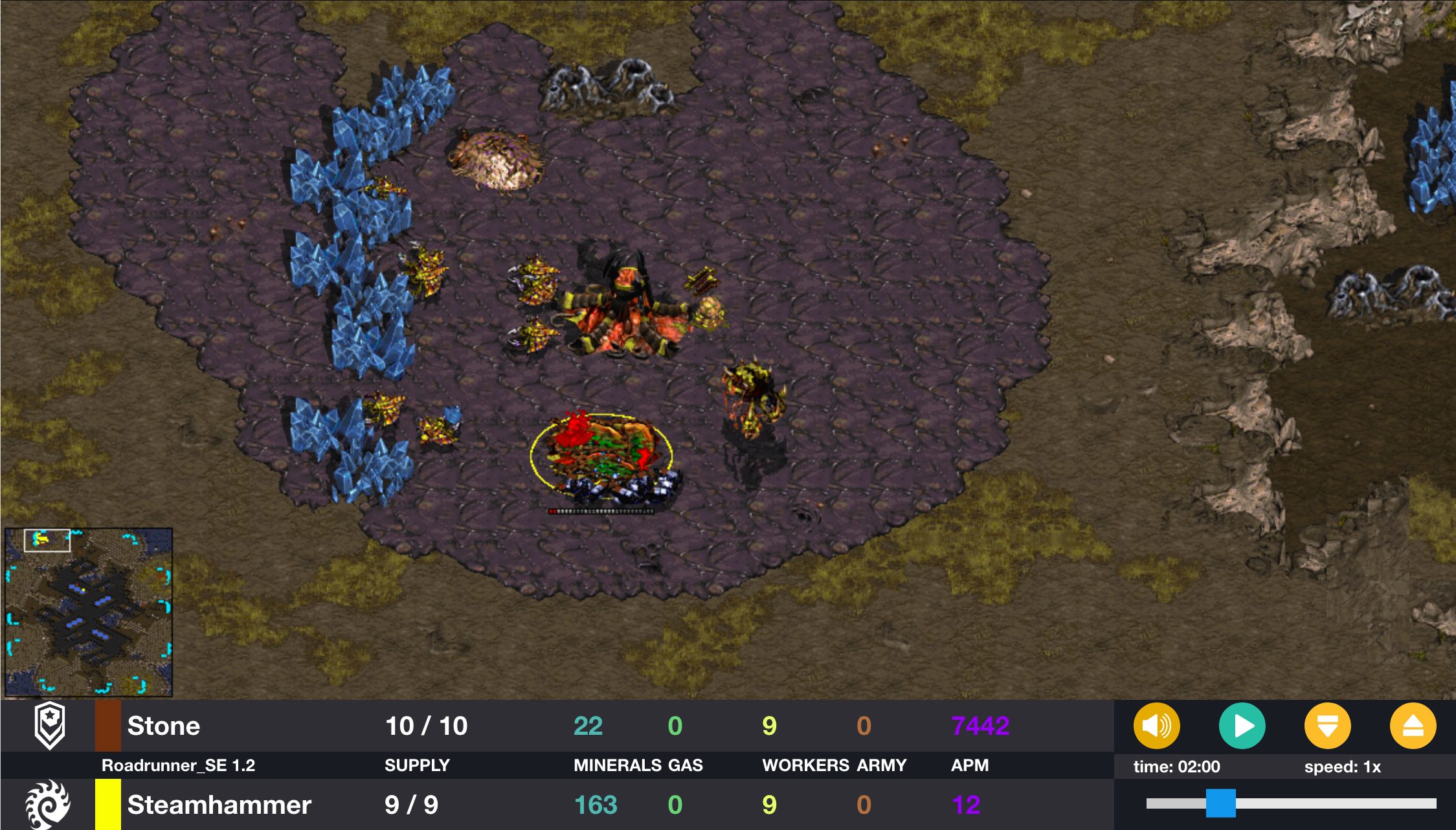
Steamhammer doesn’t react to attacks on buildings. Even so, its usual anti-rush opening defended successfully in this game. Buildings have a lot of hit points, so the spawning pool finished before it was destroyed. In the picture, the spawning pool is about to die before any zerglings are spawned, but the sunken colony is already morphing.

Steamhammer loses the pool

The sunken protected the hatchery completely, so there was little risk. Steamhammer replaced the spawning pool in the same position, which was not safe because the sunken protection extended to only one side of the pool. Stone did not seem to understand the range of the sunken, and half the SCVs sent to attack the pool were killed while standing just inside the danger zone. Steamhammer actually won the game more easily than against the older Stone version, because Stone threw away so many SCVs. Stone did point out weaknesses. Steamhammer should defend buildings which are in danger of being lost, and it needs better building placement.

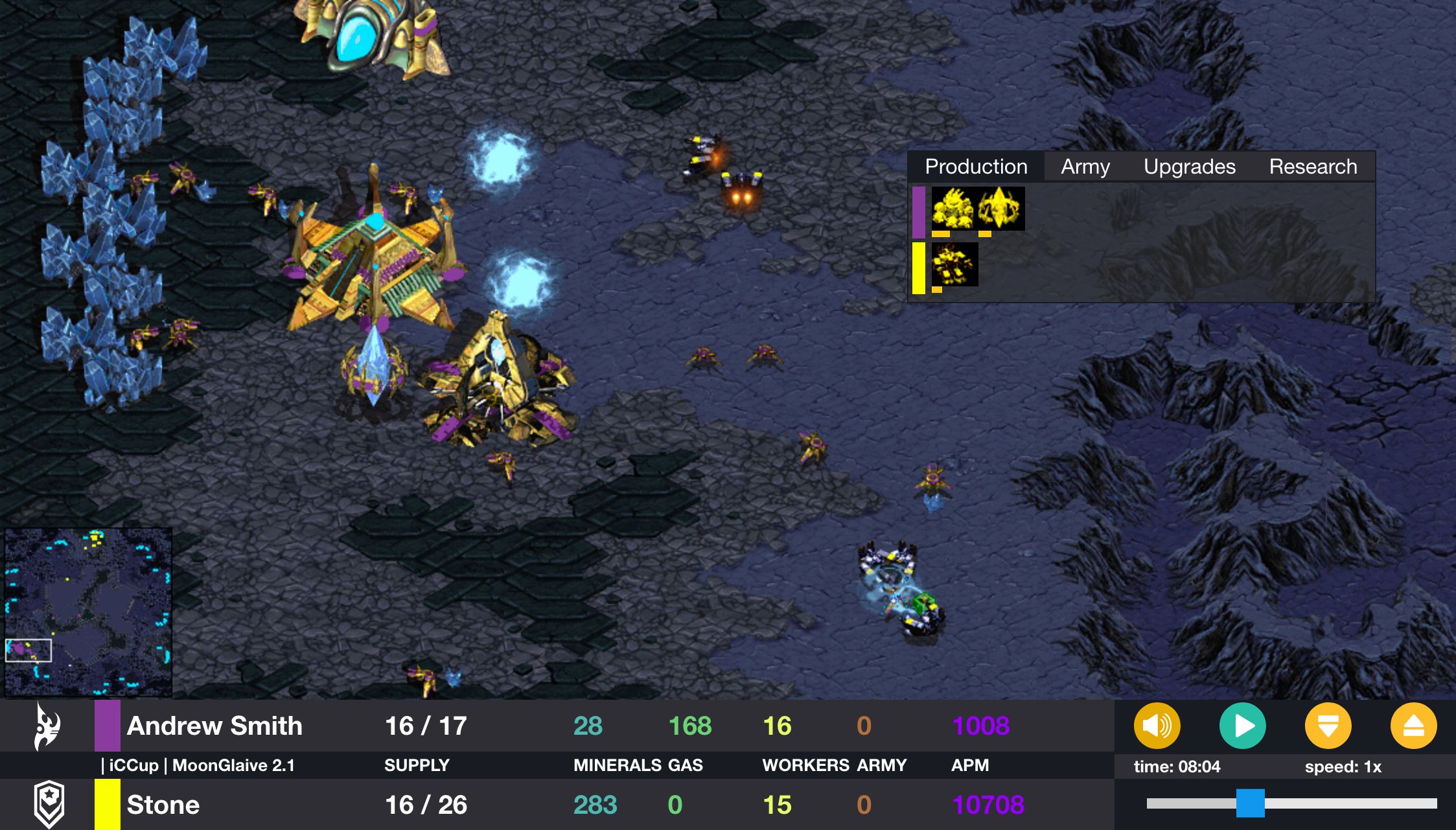
This game versus Skynet by Andrew Smith was fun. Skynet, ahead of its time as usual, does react when buildings are attacked, and pulled many probes to defend. Skynet was unworried by the skirmishes and calmly continued with its build: Late gateway, gas, cyber core... all before the first combat unit.

Skynet doesn’t care

My impression is that the change to Stone has left it weaker overall. Buildings are too hard to kill. Still, it does easily wipe out some opponents, and every change is a new challenge.

Skynet’s LatencyTracker

Back when I was analyzing Skynet’s code, a class LatencyTracker came up. It sounds like it might have to do with latency in network games, doesn’t it? Latency is a confusing issue for bots, and Krasi0 asked me to look into it. It’s been on my to-do list ever since.

It turns out that LatencyTracker has nothing to do with network latency. It keeps track of the location and duration of storm and stasis. Oh well. :-(

It’s used in only a couple places in code like this. mUnit is of type BWAPI::Unit*. isStormInRange does what its name says: Is a storm calculated to be in range of the current unit? I’m not at all sure what the practical effect of this test is, since it looks redundant. Maybe it is working around a bug in some version of BWAPI, or maybe it is used with hypothetical units that BWAPI doesn’t know about. Or something.

bool UnitClass::isUnderStorm()
{
	if(exists())
		if(mUnit->isUnderStorm())
			return true;

	return LatencyTracker::Instance().isStormInRange(shared_from_this());
}

Skynet - wrapup

Here’s what I learned in analyzing Skynet.

Skynet’s skills come across to me as first drafts of what you’d really want to implement. In looking at each one, it’s easy to see points that could be improved and shortcuts that were taken to get it working more easily. On the other hand, Skynet has a lot of different skills; the shortcuts paid off in time saved.

In other words, Andrew Smith put priority on breadth of skills rather than depth of skills. And it’s hard to argue with his choice, because Skynet is a great success, still a strong and interesting bot though its last update was in 2013.

I think it’s a key point. In a lot of posts I point out, “a better way to do X would be....” But you should only care if X is a weak point in your bot. It is better to play adequately in all respects than to play well in some and poorly in others. You want to minimize your worst weaknesses.

If you’re perfect at choosing the right unit mix to counter your opponent but your micro sucks, you lose. If you’re perfect at micro but you choose a stupid unit mix, you lose. Better to be fair-to-middling at both. Breadth of skills first.

You may be able to lift code from Skynet for your own bot, if you don’t mind being infected by its GPL license. You’ll probably have to do a bit of adapting to fit it into your own framework, but the code has clear interfaces and the important working parts seem mostly independent of the rest of the program. Once you’ve seen an idea it shouldn’t be too hard to reimplement it, either.

Skynet - avoiding splash damage

Skynet tries to avoid some area-of-effect spells and splash damage from some attacks. This is the fanciest skill that I’m writing up.

You can only avoid stuff that you can see coming. Skynet tracks threats in class AOEThreatTracker (where AOE stands for Area Of Effect), which creates and stores AOEThreat objects. Here is the key code from AOEThreatTracker::update(), which is called once per frame from the main onFrame() in Skynet.cpp:

	for each(Unit unit in UnitTracker::Instance().selectAllEnemy())
	{
		const BWAPI::UnitType &type = unit->getType();
		if((type == BWAPI::UnitTypes::Protoss_Scarab || type == BWAPI::UnitTypes::Terran_Vulture_Spider_Mine) && mUnitThreats.count(unit) == 0)
		{
			AOEThreat newThreat = AOEThreat(new AOEThreatClass(unit));
			mAllThreats.insert(newThreat);
			mUnitThreats[unit] = newThreat;
		}
	}

	for each(BWAPI::Bullet* bullet in BWAPI::Broodwar->getBullets())
	{
		const BWAPI::BulletType &type = bullet->getType();
		if((type == BWAPI::BulletTypes::Psionic_Storm || type == BWAPI::BulletTypes::EMP_Missile) && mBulletThreats.count(bullet) == 0)
		{
			AOEThreat newThreat = AOEThreat(new AOEThreatClass(bullet));
			mAllThreats.insert(newThreat);
			mBulletThreats[bullet] = newThreat;
		}
	}

Skynet recognizes enemy reaver scarabs and spider mines as splash damage threats. (A bot that might lay mines of its own should also recognize its own spider mines as threats. Skynet does not use mind control.) It also recognizes psionic storm and EMP as area effect spells to try to dodge.

What does it do with the information it’s tracking? Here’s the public interface from AOEThreatTracker.h:

	void update();

	AOEThreat getClosestGroundThreat(const Position &pos) const;
	AOEThreat getClosestAirThreat(const Position &pos) const;
	AOEThreat getClosestEnergyThreat(const Position &pos) const;
	AOEThreat getClosestThreat(Unit unit) const;

	bool isTargetOfThreat(Unit unit) const;

Psionic storm is both an air threat and a ground threat. Scarabs and mines are ground threats. EMP is the only energy threat. But of the 5 informational methods, only getClosestThreat() and isTargetOfThreat() are used in the rest of the code; the other 3 get methods serve no purpose. getClosestThreat() takes a unit and considers whether it is an air or ground unit to find the closest threat. It counts EMP as a threat to spellcasters only, even though all protoss units will lose their shields to it. It’s a little inconsistent; corsairs count as spellcasters, but Skynet never researches disruption web.

The results of all this tracking work are used in only one place, in BasicUnitAction::update(), which is a micro action like the others we’ve seen in the last days. The BasicUnitAction of course has very low priority among micro actions, so if the unit under consideration is already doing something else (like dragging the mine that is the threat), then none of this happens.

	const bool isTargetOfThreat = AOEThreatTracker::Instance().isTargetOfThreat(mUnit);
	if(!isTargetOfThreat)
	{
		const AOEThreat &closestThreat = AOEThreatTracker::Instance().getClosestThreat(mUnit);
		if(closestThreat)
		{
			const int distanceToThreat = mUnit->getDistance(closestThreat->getPosition());
			if(distanceToThreat < closestThreat->getRadius()+32)
			{
				stayAtRange(mUnit, closestThreat->getPosition(), closestThreat->getRadius() + 64, distanceToThreat);
				return true;
			}
		}
	}

First it remembers whether the current unit mUnit is the target of the threat, for later use. The explicit target does not dodge the threat (sometimes it can’t). If the current unit is not the target, but it is within range of at least one threat, then it finds the closest threat and tries to get out of its range. stayAtRange() calculates a direction and moves that way. There’s no attempt to avoid multiple threats, which are likely for spider mines; Skynet is happy to flee one and run into another. Also, I notice that AOEThreatTracker keeps careful track of each threat radius, but this code ignores it and flees to a fixed radius. I assume that’s good enough? Anyway, this limitation may explain why Skynet does not try to dodge lurker spines, which affect a long narrow area.

If the current unit is the target, the unit stays put so that the other units around it know what to do to avoid the threat. currentTargetUnit is whatever the current unit is already shooting at. This is not best if under attack by a reaver scarab, but it does help nearby units know which way to flee.

	// If the target of a threat, dont do anything to cause it to move
	if(isTargetOfThreat)
	{
		if(currentTargetUnit)
			mUnit->attack(currentTargetUnit);
		else
			mUnit->stop();
		return true;
	}

Skynet has other interesting skills. See BlockedPathManager and MineBlockingMineralTask, for example. But that’s enough for now.

Tomorrow: Wrapup and lessons learned.

Skynet - arbiter control

Arbiters are tough to use well. You want to maneuver your arbiter to cloak as many of your units as possible while staying safe. You want to stasis or recall at critical times and places. Occasionally you want to do damage with the pea-shooter. The goals pull in different directions, and you have to decide what’s best.

Here’s how Skynet decides. Skynet has two arbiter skills: It knows how to cloak units efficiently and how to stasis. Skynet does not use recall, and it (understandably) doesn’t put any emphasis on targeting enemies with the puny gun.

Arbiter control is in ArbiterAction::update(), which is like the other micro actions, set up by Behaviour::createDefaultActions(). First it considers stasis:

	if(mUnit->getEnergy() >= 100 && BWAPI::Broodwar->self()->hasResearched(BWAPI::TechTypes::Stasis_Field))
	{
		const int stasisSize = 48;

		bool stasisUrgently = false;
		if(UnitInformation::Instance().getUnitsTargetting(mUnit).size() >= 6 || (UnitInformation::Instance().getUnitsTargetting(mUnit).size() >= 1 && mUnit->totalHitPointFraction() < 0.3))
			stasisUrgently = true;

First, if stasis is possible and the arbiter is in danger of being lost, Skynet sets stasisUrgently to true.

		UnitGroup stasisChoices;
		for each(Unit enemy in UnitTracker::Instance().selectAllEnemy())
		{
			if(!UnitHelper::isArmyUnit(enemy->getType()))
				continue;

			if(enemy->isUnderStorm() || enemy->isStasised())
				continue;

			const int distance = mUnit->getDistance(enemy);
			if(distance > 250 || distance < stasisSize)
				continue;

			stasisChoices.insert(enemy);
		}

Then it comes up with a list of candidate enemies to stasis. Enemies under psionic storm are not candidates—let them suffer!

		if(stasisChoices.size() > 4 || (!stasisChoices.empty() && stasisUrgently))
		{
			UnitGroup stasisTargets = stasisChoices.getBestFittingToCircle(stasisSize);

			if(stasisTargets.size() > 4 || (!stasisTargets.empty() && stasisUrgently))
			{
				const Position &stasisLocation = stasisTargets.getCenter();
				if(mUnit->getDistance(stasisLocation) <= BWAPI::TechTypes::Stasis_Field.getWeapon().maxRange())
				{
					mUnit->useTech(BWAPI::TechTypes::Stasis_Field, stasisLocation);
					LatencyTracker::Instance().placingStasis(mUnit, stasisLocation);
					return true;
				}
				else
				{
					mUnit->move(stasisLocation);
					return true;
				}
			}
		}
	}

And finally Skynet decides whether and where to stasis. If it can stasis at least 5 enemy units, or at least 1 unit and stasisUrgently is set, then it does. UnitGroup::getBestFittingToCircle() finds a circle of the given size which covers as many units in the UnitGroup as possible, and returns the smaller UnitGroup which it covers.

It’s a simple heuristic. An arbiter will happily stasis 5 vultures uselessly when it reaches stasis energy after the army it was covering is destroyed by tanks and vultures. The “right” way to do this would be with a pay-me-now-or-pay-me-later tradeoff that compares the situation now with possible future situations, which would of course be far more complicated. And, since that’s not hard enough yet, it should also consider the effect on the battle: Stasis on a ramp to block reinforcements? Stasis the tanks that are doing the most damage, or the vessel that is detecting the cloaked army? And so on.

Next is maneuvering the arbiter to cloak units:

	UnitGroup unitsToCloak;
	for each(Unit unit in squadUnitGroup)
	{
		if(!UnitHelper::isArmyUnit(unit->getType()))
			continue;

		if(unit->getType() == BWAPI::UnitTypes::Protoss_Arbiter || unit->getType().isBuilding())
			continue;

		if(mUnit->getDistance(unit) > 250)
			continue;

		unitsToCloak.insert(unit);
	}

	if(!unitsToCloak.empty())
	{
		unitsToCloak = unitsToCloak.getBestFittingToCircle(136);
		if(!unitsToCloak.empty())
		{
			Position cloakLocation = unitsToCloak.getCenter();
			if(mUnit->getDistance(cloakLocation) > 110)
			{
				mUnit->move(cloakLocation);
				return true;
			}
		}
	}

Candidate units to cloak are basically military units in the squadUnitGroup which can be cloaked and are near enough. Skynet never tries to protect probes or observers with the cloaking field (UnitHelper::isArmyUnit() returns false for both), but it will try to cloak dark templar that are already cloaked (a simple omission from the above code and trivial to fix) and units that are already covered by another arbiter (only a little harder to fix). It does the getBestFittingToCircle() thing to find the largest circle of units that it can cloak, and moves toward the circle’s center if it’s not close enough. If it’s already close enough then the micro action does not occur, which I assume frees the arbiter to fire its gun when possible, flee danger within limits, and so on.

Tomorrow: Avoiding splash damage, finishing the series.

Skynet - mine dragging

Spider mines do a ton of splash damage when they explode, and they don’t discriminate. Everything in splash range suffers, enemy or friendly. So it’s popular to intentionally trigger enemy mines while running up to enemy units, dragging the mine into the enemy to cause damage. Mines can sometimes follow a unit for quite a distance before going off. Protoss usually drags mines with zealots, though dark templar are also good. Zerg usually uses speedy zerglings in small groups, because they’re cheap and fast. Terran can sometimes trigger enemy mines with drops, but doesn’t have an appropriate unit to drag mines otherwise.

Skynet knows how to drag mines with a zealot. It uses the same system of micro actions that I touched on yesterday. In Behaviour::createDefaultActions() it records a possible mine drag micro action for every zealot:

	if(unitType == BWAPI::UnitTypes::Protoss_Zealot)
		mMicroActions.push_back(MicroAction(new MineDragAction(mUnit)));

By the way, the micro actions are evaluated in Behaviour::update(), which checks them in order. Each unit can only execute one micro action at a time, and the first action to return true is what happens. Skynet’s only prioritization is to record the most important micro actions first in createDefaultActions(). Mine dragging is recorded near the end, as a low-priority action. Yesterday’s archon-zealot undetected unit attack is higher priority.

Here is the entirety of MineDragAction::update():

bool MineDragAction::update(const Goal &squadGoal, const UnitGroup &squadUnitGroup)
{
	for each(Unit unit in UnitInformation::Instance().getUnitsTargetting(mUnit))
	{
		if(unit->getType() == BWAPI::UnitTypes::Terran_Vulture_Spider_Mine)
		{
			int distance = std::numeric_limits<int>::max();
			Unit closestUnit;

			for each(Unit enemyUnit in UnitTracker::Instance().selectAllEnemy())
			{
				if(enemyUnit->getType().isFlyer() || enemyUnit->isLifted() || enemyUnit->getType().isBuilding() || enemyUnit->getType() == BWAPI::UnitTypes::Terran_Vulture_Spider_Mine)
					continue;

				int thisDistance = mUnit->getDistance(enemyUnit);
				if(thisDistance < distance)
				{
					distance = distance;
					closestUnit = enemyUnit;
				}
			}
			
			if(closestUnit && distance < 32*5)
			{
				mUnit->attack(closestUnit);
				return true;
			}
		}
	}

	return false;
}

This seems to only notice spider mines which have already popped up and are targeting the current zealot. If one is found, then the code checks for suitable enemy units (not stuff in the air, for example) that are close enough. If any is found, then the zealot targets the nearest for attack, end of story.

That’s basic mine dragging. A stronger version would also consider detected or remembered mines: If a mine in the ground is detected or remembered to be near valuable enemies, then check whether it can be activated and dragged into the enemies. You can remember a mine location if you detected it in the past, or if you saw it being laid or moving and reburrowing. That’s more complicated, but human players do it as a matter of course. Humans will even try to drag mines that they expect or hope are there, without being sure.

Tomorrow: Arbiter control.

Skynet - killing undetected units

Archons do splash damage that affects all enemy units, included undetected units. That means that you can use an archon to, for example, kill a burrowed lurker that you can’t detect, by attacking one of your own units. The usual way is to park a sacrificial zealot on top of the lurker and attack the zealot with the archon; the archon will do full damage to the zealot and splash damage to the lurker.

Archon splash affects both ground and air. An archon attacking a zealot will damage a cloaked wraith that is in splash range. An archon attacking a floating ebay should clear spider mines in a small area (I haven’t tested to make sure).

Here’s how Skynet does it. Behaviour::createDefaultActions() recognizes the unit types and records possible micro actions to test and execute later:

	if(unitType == BWAPI::UnitTypes::Protoss_Zealot || unitType == BWAPI::UnitTypes::Protoss_Archon)
	{
		firstTargets.insert(BWAPI::UnitTypes::Terran_Siege_Tank_Siege_Mode);
		mMicroActions.push_back(MicroAction(new ArconZealotKillUnDetected(mUnit)));
	}

When the micro action comes up for testing, it runs ArconZealotKillUnDetected::update(), which either fails the test and returns false or succeeds, executes the micro, and returns true. Given the original archon or zealot in mUnit, it looks for the closest enemy unit that meets the conditions:

	Unit lurker;
	int lurkerDistance = std::numeric_limits<int>::max();
	for each(Unit unit in UnitTracker::Instance().selectAllEnemy())
	{
		if(unit->exists() && !unit->isDetected() && (unit->isCloaked() || unit->getType().hasPermanentCloak() || (unit->getType() == BWAPI::UnitTypes::Zerg_Lurker && unit->isBurrowed())))
		{
			int thisDistance = mUnit->getDistance(unit);
			if(thisDistance < lurkerDistance)
			{
				lurkerDistance = thisDistance;
				lurker = unit;
			}
		}
	}

	if(!lurker || lurkerDistance > minDistance)
		return false;

The variable is called “lurker” but it looks for any unit that is undetected and is temporarily cloaked (like a wraith or a unit under an arbiter), permanently cloaked (like a dark templar), or is a burrowed lurker. I skipped over the next bit of code: It checks for the other unit (of type typeToFind) and if it’s close enough puts it in other; if it has a zealot it looks for an archon, or if an archon it looks for a zealot. If it finds the needed other unit, it executes the micro:

	if(typeToFind == BWAPI::UnitTypes::Protoss_Archon)
	{
		if(mUnit != UnitTracker::Instance().selectAllUnits(BWAPI::UnitTypes::Protoss_Zealot).getClosestUnit(lurker))
			return false;

		mUnit->move(lurker->getPosition());
		return true;
	}
	else
	{
		if(otherDistance <= 14)
		{
			mUnit->attack(other);
			return true;
		}
		else
		{
			mUnit->move(other->getPosition());
			return true;
		}
	}

If the unit is a zealot (because typeToFind is archon) and it’s not the closest zealot, it bails so that the target doesn’t get swarmed by zealots—one volunteer at a time, please! The zealot moves to the position of the target. If the unit is the archon, it moves toward the zealot (not toward the target; this corrects for miscoordination that could occur if there’s more than one target around) or, if the zealot is within splash range of the target, attacks the zealot.

The bottom line is that Skynet has the basic skill, but its implementation is not sophisticated. It knows all the possible targets, but can only use a zealot as the sacrifice—pros in a pinch will use anything that works as the sacrifice. It doesn’t know that it could use a reaver instead of an archon. It doesn’t consider whether the sacrifice is worth the damage to the target (you’ll hurt your zealot and the cloaked wraith will probably escape). It does no preparation (keep the archon and zealot near each other if they may need to work together) and minimal coordination (if there’s an observer just out of range and approaching, you shouldn’t have bothered; if you have high templar around maybe you should storm it). If the target evades, Skynet may keep microing both units, leaving them out of the fight. But of course most bots don’t have even the basic skill.

Reminder: Other units that do splash can also kill undetected enemies this way. Reavers, sieged tanks, and lurkers are the prime splash-dealing candidates. Corsairs, firebats, valkyries, and infested terrans also have occasional uses. (Mutalisk bounces are technically not splash and do not hit undetected enemies.) And, of course, spell effects like nuke, irradiate, psionic storm, ensnare, and plague affect units whether they are detected or not. Ensnare and plague are particularly useful because they make cloaked units visible.

Near the end of this 2008 game, Stork fires on his own carriers with corsairs to hold off cloaked wraiths.

Tomorrow: Mine dragging.
Skynet skills

I meant to write another post or two about how particular bots keep their squads in formation, but after grepping source code for every keyword I could think of, I didn’t turn any up. We already know that OpprimoBot keeps its squads compact with a flocking algorithm, so my search was definitely not comprehensive... but I still gave up.

Instead I’ll write a short series about interesting skills coded into Skynet. Of bots whose source I have, the three candidates for Bot With the Most Hand-Coded Skills are ICEbot, Skynet, and Tscmoo, and Skynet is the easiest to read.

As an appetizer, here is a comment from TaskManagerClass::getPriorityList, which sorts tasks related to build order, research and production into priority order:

	// If I am vulnerable to counter attack / have no map control, place defense higher
	// If I am not behind on army size but its not safe to attack, tech
	// If I am not behind on army size but its safe to attack, produce
	// If I'm behind on army supply, produce

The ideas in the comment are not implemented. Skynet is already one of the cleverest bots in adapting its build to the game situation. Imagine how much cleverer it could be if Andrew Smith had had enough time to implement these ideas.

Tomorrow: Killing undetected lurkers.