Utena - bed catalog
Beds go with sleep, so they are tied to dreams, as well as to ignorance via forgetting and the metaphor of Buddhist awakening. And beds go with sex. Therefore beds stand for Manichaean evil: Ignorance and sex are the prime attributes of the dark world (Akio’s world) in that religion. Another symbol of the patriarchy is poison, or toxicity in general (often marked by the color purple). Sickbeds tie into that metaphor.
Literal beds are on the left, metaphorical beds on the right. (Oops, it’s the opposite of Utena’s symbolism. Well, imagine that the literal beds are illusions and the metaphorical beds are real.)
See other notes - the bunk bed. The upper bunk is decorated with a male symbol, the lower with a female symbol. Utena takes the top bunk without comment. It’s about the arbitrary placement of the male social role above the female role. It’s implied to be ignorant.
The rails prevent occupants from falling out of bed. They are trapped in their roles. The bunk bed looks old-fashioned and heavily built.
Little Miki is sick in bed. He blames himself for breaking his promise to Kozue, where he ought to blame his parents for not having him vaccinated (common in Japan due to a historical case of bad vaccine that caused mass illnesses). Everything is green and blue-green for control, which could be the control exercised over Miki, or the control over Kozue through their parents. It suggests that Anthy arranged events. If so, did she somehow infect him? It’s not impossible.
The bedside lamp looks ahead to the episode 33 lamp that Utena turns off, choosing darkness. Miki chooses darkness in blaming himself.
Miki imagines Touga posing in bed with his shirt open for sex. This is after Miki collides with Kozue as she leaves Touga in the music room. Touga convinced Miki to fight for Anthy, but the sequence shows that Miki saw a threat to Kozue, who he must protect. No matter how much she irritates him, Miki and Kozue are inseparable.
Compare the real bed below, which shows Touga much worse. I put it next, out of order.
Touga in bed at the end of the episode, talking on the phone with End of the World, who hears nothing he did not already know. Touga and four girls are silhouetted behind a gauzy curtain, meaning concealed evil. Touga’s bandage is surely much larger than his injury justifies. Enough details are visible that we might detect clothing if the artists had chosen to draw any. The hanging cord looks like a bell pull to summon a servant. The future patriarch does not hide his activities from the family servants. He probably couldn’t if he tried.
Apparently the girl who acts as Touga’s pillow is favored at the moment. Does the girl out of sight behind the bed feel slighted? I imagine they all want to be as close to him as possible.
The high jump mat (a landing pad) resembles a bed. Does it participate in the meaning? Apparently not. It is sports equipment and positioned on a running track, which suggests action and progress. On the other hand, the mat is blue for illusion, Utena is facing left, and the blue-green on either side of the track reminds me of gutters, a symbol of Akio’s “guidance”. It seems to be progress in the wrong direction. So it has something to do with beds after all.
I judge Utena’s jump to be high for her age, but not miraculous. Compare her miraculous leap in the episode 21 duel against Keiko.
Nanami sits up in her large bed and looks out the large window. Moonbeams from Akio’s moon slant left; compare white sunbeams. The blanket is pink and the pillow is white, suggesting that she dreams of Utena, or else that she is a lesbian and dreams of the prince. (Those two things might be the same.) On the S-shaped bed the pillows seem to stand for dreams, and it should be general. But the bolster is purple, presumably because Nanami’s dream of Touga is corrupt or due to corruption.
Why does the foot of the bed have this curious design, with wings and extra feet? It is emphasized by the angle of the image, and it must mean something. Could it be a coffin? The horizontal bar, brass-colored for the prince, has curved “supports” and reminds me of the broken bridge that the prince could not cross, which can be read as a symbol of death. This bridge is not broken, though it is on a blue-green background.
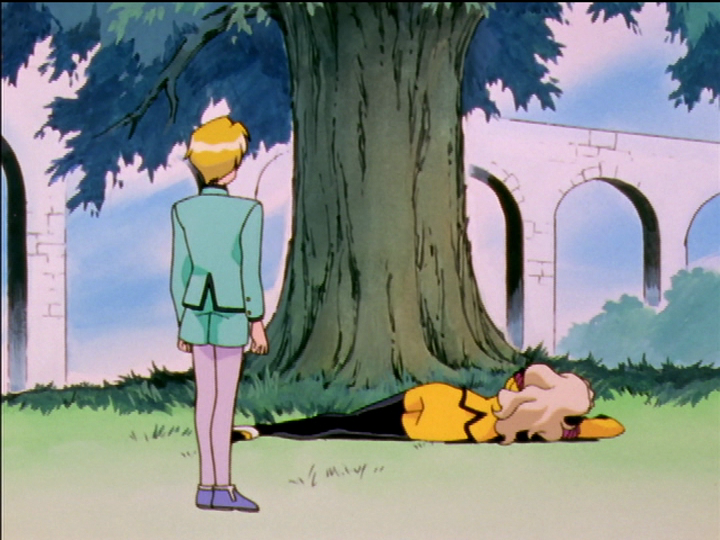
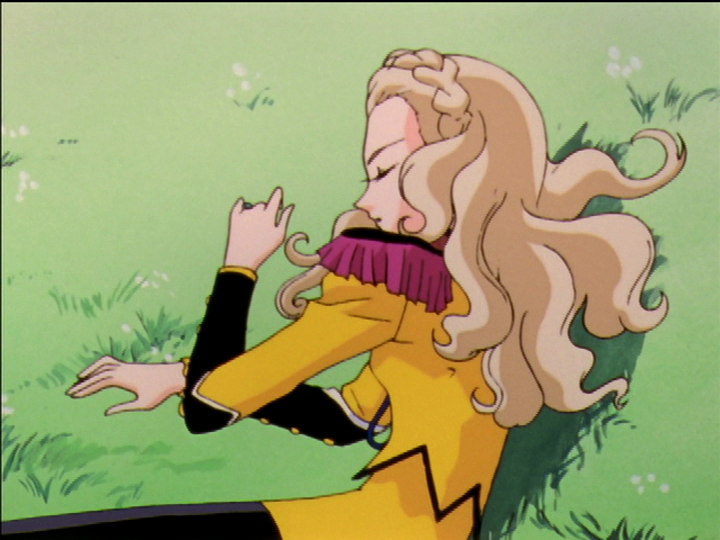
Nanami the cow lies on a bed of grass. Left, she has just eaten a batch of sandwiches and goes to sleep. See cool stuff - sleep after eating. Right, though it looks about the same, Utena has removed her cowbell and she sleeps and forgets like a losing Black Rose duelist.
Sleep is associated with forgetting, and sleep is associated with defeat. Compare the start of episode 37, where Utena stays up all night and remembers part of the prince story—it is a step toward her victory.
Akio is busy separating Nanami and Touga. Left, the blanket or bedspread has become bright pink. Nanami looks at green photos. The light through the window is white for the prince.
Right, the photos are scattered on the floor. Now the photos and album are white, maybe for Nanami’s lost prince Touga. If you read the pink as Utena, saying that Nanami wants Utena in her bed, then the white here (and the white window on the left) could be for Utena. Then the yellow on the left makes sense too, and so does the blue out the window here. You can read the pink as homosexuality broadly, which is usually what it seems to mean in clothing. In that case I’m not sure how to interpret the other colors.
Mitsuru is in a dark place. He sits on the bottom bunk—the girl bunk, taken by Anthy and not by Utena. There is no sign that he has a roommate; only the lower bunk is mussed. The storage underneath is yellow and blue. The wall is decorated with a white car image, the prince’s car. He’s not old enough for it to be red. The soccer ball is symbolically female, and it is a boy’s plaything. Women are to be kicked toward a goal, which for soccer is a sex symbol and a trap symbol that stands for marriage. Utena participates in the same symbolism, and the ball is black and white, that is, mixed light and dark, like Utena.
Akio’s car is a bed for sex. Akio shows it off himself. Here, Nanami shows it off. Ruka and Shiori have car sex. Only Wakaba avoids it, riding in the car for nothing more than a date. Which is not unrelated.
For teenagers, dates and sex rendezvous are classic uses for a car, and have been at least since the 1950s.
The white sofa is a bed for sex. With the car, that makes two beds for sex, one loud and public, one quiet and private.
There is no sign that Akio has a bed for sleeping. He never looks tired; the closest he comes to showing tiredness is before the episode 32 breakfast, when he speaks quietly because Utena is not fully awake yet. I think Akio does not sleep. The night is his time of power; he does not sleep through it. As an allegorical abstraction, he is always active. As the Christian devil, or the Manichaean dark king, he is a supernatural being.
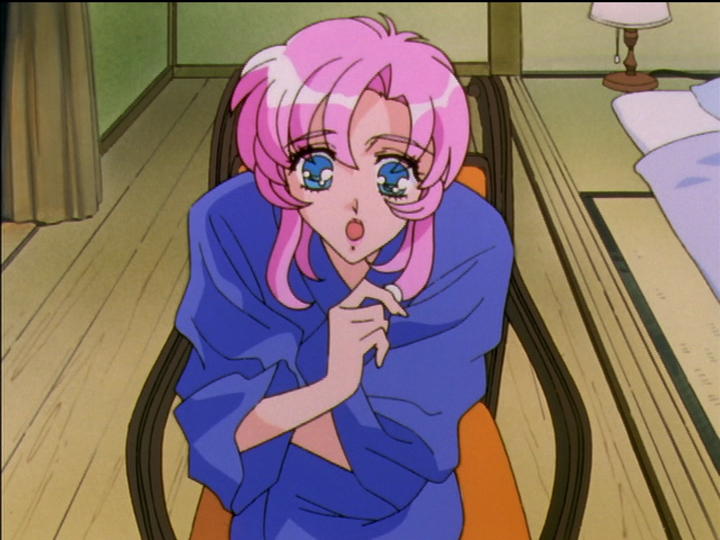
In the First Seduction we don’t see the hotel futon as a whole, only enough to tell what’s going on. Utena knows it is a bed for sex, but while she waits for the event, she pulls up the covers as if intending to sleep. She was comfortable wearing the yukata around the room, but now adds another layer. I suppose it is a psychological defense; she is anxious and hides from the sex that she was tricked into wanting. Her disjointed babble shows how extreme her misgivings are.
Everything in the hotel is under Akio’s control, Utena included. Of course it’s not a bed for sleeping. Akio doesn’t have those.
We don’t see what Anthy is lying on, but functionally it is a bed for sex. Immediately above, Utena covers up her desire for sex. Here, Anthy is revealed by a curtain. Both are gestures toward concealment, somewhat like a stage curtain. See comparisons - Anthy provides power for more on the image. Compare Touga’s imagined and real veiled beds, above.
Curtains around a bed make it high-class. Utena’s blanket is low-class. Touga seems to have absorbed Akio’s value system.
beds of straw
I count these as literal beds because they are used for all the same purposes. These four images are in the comparison catalog with different information.
Utena lies on the grass sometimes. Could that be related to the beds of straw? She is a cow, at least when in love with Akio and arguably until the final episode because of her love for Dios, so it’s plausible.
In a dream as Nanami becomes a cow, she wakes up from a bed of straw. Like a condemned prisoner, she is offered breakfast before being sent to the slaughter.
Hay as a bed to sleep in and hay as food.
Anthy and Mitsuru sit on a pile of straw. Compare Mitsuru sitting on his own bed, above—this Mitsuru is more relaxed. I take it to be Anthy teasing Nanami as part of her plot.
I think the main point is that Anthy is a cow too. It is hay as food. See Nanami becomes a cow for what it means to be a cow. I suppose Mitsuru is an up-and-coming bull.
Above, Nanami slept on hay. Here Mitsuru’s movie scene promises sex on the hay. See comparisons - romp in the hay for the main discussion.
Hay as a bed for sex.
Hay as a bed to lie in while recovering. Compare Miki’s sickbed above. But we can guess that the image of Anthy on Dios is on the hay as well, so it is also hay as a bed for sex. And of course Anthy is already a cow. This image refers to all three of the above images.
One way to read it is that Anthy became metaphorically pregnant and gave birth to Akio. The hay is white for the prince, but you could say it is in the shape of a sperm. Do you have a different interpretation? It could be a comet.
coffins and graves
Graves are often compared to beds, for those sleeping “the sleep of death.” And here are the graves of Utena’s parents in the children’s cartoon version of the prince story. They are laid out like beds, with headstones like headboards. Were the parents “cultivated” like Utena? The headstones are decorated with plant images. When we see the cemetery more directly in episode 9, we mostly see tall standing crosses.
Metaphorical death means believing in the illusions of the world (as Buddhism puts it) or in being ignorant (as Manichaeism puts it, with a similar meaning). Curiously, the religious symbolism attached to the Christian graves is not Christian. Literal death is about Akio’s power. Those who die unawakened (in both Buddhism and Manichaeism) are reincarnated and support Akio’s power. Compare Mikage returning as if alive. Those who die awakened, like Utena (see victory symbols), are not reincarnated and reduce Akio’s power.
Anthy lies in fetal position in her coffin, and little Utena’s posture is not much different. They are metaphorically not born yet—the coffins are the egg of the world that they must crack open. Well, Touga opens Utena’s and Utena opens Anthy’s. See the big idea - victory symbols for context.
Anthy’s episode 39 coffin hair is in full-on monster mode. In the coffin she is the real Anthy and can be herself.
The Black Rose corpse drawers are coffins, never mind that they fall into the flames of annihilation. The contents are usually fitted to Mikage’s victim that episode (episode 14 with Kanae seems to be the one exception, and we don’t see inside the drawer in episodes 21 or 23). Here are the twin boys for Kozue’s duel. They have corresponding hair colors, they hold hands, they face opposite directions, and their shoes seem to wedge them apart, all points parallel to Kozue and Miki. Kozue and Miki are one person, so their duelist boys are the same. Other duelist boys generally match Mikage’s victim only.
The left one, with purple hair, should correspond to Kozue, and the right one to Miki. The hair colors and the left-right symbolism support it.