archive by month
Skip to content

fitting tournaments into the calendar

About a dozen bots have been updated in the last week, and a bunch of new bots have been uploaded this month. We’re going through a burst of activity similar to the one around the previous SSCAI tournament.

The reason might be that the CIG tournament is coming up. The timing fits, but other evidence is not as clear. I don’t see an upcoming tournament as a good reason to release new rushbots, or to put out an instance of McRave playing terran (Sparks). But only the bot authors know their own motivations. Maybe some will comment?

A tournament in April or thereabouts might be a good way to maintain interest, if tournaments really are good motivation. Thinking about the timescale on which interest waxes and wanes, I guess April would be about right, depending on how long the tournament runs. The CIG and AIIDE tournaments are tied to academic conferences and can’t be moved around the calendar, and SSCAIT traditionally runs starting near the end of the year. It’s possible that a gap-filling tournament, if people see it as important, might keep the scene lively. Well, it’s a speculative idea, but spacing tournaments around the calendar makes sense. Authors should have time to make updates before the next submission.

Sparks, by the way, has a pretty good strategy. It is McRave set to play terran, and obviously some thought has been put into the terran, though McRave’s protoss play is more sophisticated (so it will presumably play as protoss in tournaments). I imagine it is named after “sparks terran,” which was traditionally a sunken bust timed for just before mutalisks came out. (Sparks terran is a strategy I’ve been keeping in mind as tough for a zerg bot to counter when following a mutalisk plan. Luckily for Steamhammer, it’s not easy to implement well. Tscmoo comes closest but is missing skills.) Today people often say “sparks terran” and mean nothing more than straight infantry play.

Anyway, Sparks the bot opens with 2 barracks and puts its first marines in the mineral line for safety. When it has enough it transfers them to the ramp, arranging them in a nice arc. When stim is done, upgrades are started, and medics are available, it moves out to attack. A terran should stop the attack easily; a protoss shouldn’t have much trouble if it saw what was coming; but a zerg needs to pay attention and defend smartly to hold. It’s a good attack timing.

new LetaBot human and machine tournament

Martin Rooijackers aka LetaBot is running a Mini team melee + bots tournament in a week, on next Saturday. As usual there are curious experimental rules, this time team melee games for human players. Bots will play ordinary 1v1 games and will notice nothing out of the ordinary.

These tournaments are small and super easy to participate in. If you let LetaBot know you want to play, he can take care of everything. Afterward you can download the replays. I recommend it.

I really want Steamhammer to play, but it has a deadly bug: It can’t play on LAN latency (or higher). It drops steps from its opening build and gets completely messed up, and there’s no point in playing like that. Maybe I can fix it in the next week....

Update: The tournament has been postponed. See the original announcement thread.

BWAPI 4.2.0 and CIG 2017

I heard back from the CIG 2017 organizers. They wrote that the contest will support BWAPI 4.2.0 “if there’s no special issue,” and that details will be announced later.

So: They haven’t decided for sure. I expect that there will be no issues and they’ll adopt it, but the decision is not set in stone.

In my experience, most academics are extremely busy, which is not ideal since good scholarship calls for time and concentration. I think the CIG organizers are no different.

Steamhammer-Microwave razor close game

SSCAIT’s mini-tournament is not quite finished as I write.

The irritating news of the tournament: Steamhammer played 2 tournament games versus XIMP by Tomas Vajda, plus one game shortly before the tourney, on the same map (Benzene) with the same starting positions (protoss on the left, zerg on the right). Just how random is it? The 3 games were nearly identical, down to individual army movements, and Steamhammer lost, as it should have, because it doesn’t understand map blocks and couldn’t finish its opening build. Sometimes luck hits like a truck.

The interesting news of the tournament: Tscmoo protoss is doing surprisingly well, including against opponents that it has a mixed record against. Did its opening learning, which was reset in December, finally gather enough data to make good decisions? We’ve seen before that Tscmoo brings its best against strong opponents. What’s behind that?

A razor close game between Steamhammer and Microwave on Python: Steamhammer opened with overpool into fast spire, while Microwave went overpool with zergling speed and mass lings, leading to a later spire. Steamhammer made 2 sunkens with its spire. When Microwave’s zergling numbers grew large enough, it defeated Steamhammer’s lings and pushed in; the sunkens and 2 fresh zerglings were barely enough to hold them off. When its faster second hatchery came online, Microwave attacked again; the second wave killed the sunkens and a couple of drones, but the first mutas cleaned up. The third wave left 2 Steamhammer drones alive, and by then Microwave’s spire was up too, and soon Microwave destroyed Steamhammer’s spire. Steamhammer scourged an overlord, which delayed Microwave just enough. Here Microwave is adding drones when it should be replenishing its army.

Steamhammer’s spire is destroyed

If you make too many drones in ZvZ, you die. Microwave was behind in air power and did not keep the pressure on. Steamhammer killed another overlord, outmicroed the scourge...

Steamhammer outmicroes scourge

... and brought down the excessive number of drones while defeating mutalisks that spawned one at a time. Microwave helped by transferring drones from its natural to the main where the mutas were. Microwave might have held if it had gotten up a spore colony in time, but it was too late.

Steamhammer clears drones and mutas

SSCAIT Ladder Tournament series

For anyone who hasn’t noticed, the second weekly SSCAIT Ladder Tournament is underway. Here’s the tournament series main page so you can follow along as more of these little competitions come up.

Now, if you’ll excuse me, I need to go do something to prevent the zerg column in the tournament participant tables from growing even longer. 6 of the 13 bots this week are zerg and share common heritage in their family trees. Tonight I’m implementing stim for terrans. Steamhammer’s terran infantry skills are almost good enough to pose a serious threat to zergs—just a couple more skills....

SSCAIT semifinals and third place playoff, part 2

Today is the second and more interesting part of the SSCAIT 2016 round of 4. Krasi0 fought XIMP, with the winner to move on to the final. The loser went to a 3rd/4th place playoff match against Iron.

Krasi0 vs XIMP

Game 1 was on Empire of the Sun. XIMP is the carrier bot. Terran Krasi0 saw what was coming and chose to attack with tanks and early goliaths before the carriers had all their interceptors. The tanks were somewhat inefficient in sieging down the cannons (most bots are), but they were fast enough. XIMP was in trouble regardless, but losing too many probes sealed it.

Game 2 was on Heartbreak Ridge, a 2-player map. It has many cliffs which favor carriers, but it also has low-ground bases and a short ground distance between the mains, which favors mech attacks. Krasi0 attacked with the same timing as the previous game. Krasi0 again killed the natural, but terran reinforcements chose a path through the center which took them next to the protoss base, distracting XIMP into playing correctly against the reinforcements instead of the main terran force. Krasi0 could have sent fresh units the other way around the center of the map, where carriers could not have engaged them until they arrived. Then the mech army would have stayed compact.

But as it happened, the diversion toward reinforcements and Krasi0’s difficulty in attacking the protoss main through the very narrow entrance meant that the carriers were able to build up interceptor numbers. XIMP defeated the goliaths and started chasing the terrans away. Krasi0 sent goliaths piecemeal toward the front and lost them a few at a time.

While one carrier group fought terran units around the center, another group departed on XIMP’s trademark edge crawl to survey the bases around the map and attack from the rear, a slow but dangerous plan. Both players were in some trouble. XIMP had only its main left and no long future unless it could take and hold another base, while Krasi0 had 2 bases but not enough anti-air to stop the carriers. What would happen?

XIMP’s front carriers played poorly and lost numbers. They could have returned through the center to cover while XIMP retook its natural, or they could have joined the attack on the main where cluttered buildings made goliaths awkward, or they could have circled the terran natural and attacked it from above the cliff, but they insisted on attacking from the front without the advantage of a cliff. With that decision, Krasi0 had the lead. Terran should have sent its ground army, minus air defense, to the protoss base, which would either cause a base race or bring the carriers back home to defend. Instead Krasi0 left tanks and vultures idling around the center of the map. Krasi0 did not use its lead.

Neither side was making the most incisive moves, and the outcome was unforeseeable. Fun game!

Krasi0 got a third base up. XIMP had no money but destroyed the terran main, slowly. Krasi0 did not try to float its factories, but rebuilt from scratch instead. Finally Krasi0 built up enough stuff to start hitting carriers, and that was enough.

Both players fought like lions. After mistakes all around, the victory was narrow. Krasi0 won and went to the finals.

Lesson: You never know what little thing will make the difference. A small improvement by XIMP (try to attack from above cliffs, or destroy bases more efficiently) or a minor weakness in Krasi0 (build the 3rd too late, be unable to recover from losing all tech) could have given us a different result.

Iron vs XIMP

Iron is far more aggressive than Krasi0. Iron attacked with infantry and tanks, sieged down the cannons, held off carriers with marines and turrets, finally added valkyries almost as an insult, and won easily. The second game went about the same way. A group of carriers escaped and caused damage, but only until the undefended protoss base died.

It’s not easy to beat XIMP, or more bots would do it, but Iron made it look easy.

SSCAIT semifinals and finals, part 1

This post is about the boring stuff that happened in the SSCAIT semifinals and finals. I’m saving the most interesting games for a later post. It’s all part of my natural laziness—er, I mean, cruelty.

The round of 4, aka semifinals, was played as best-of-3. The winners moved on to the final, which was best of 5.

round of 4: LetaBot vs Iron

LetaBot played its SCV rush. Iron’s author Igor Dimitrijevic reported (in a comment) that Iron easily beats Stone’s SCV rush. But LetaBot’s rush is more aggressive than Stone’s, and LetaBot won 2-1.

Game 2 was the only interesting one. Iron did not adapt its build to the emergency and started a second factory instead of building a vulture from the first and winning. When Iron lost all SCVs, it still did not cancel the unfinished second factory and win. Instead, LetaBot was cleaning up Iron’s base and killed the second factory, releasing its cost so that Iron could build vultures from the first factory, which it did, and won.

Lesson: Apparently not enough opponents have put early pressure on Iron. It hasn’t needed to adapt in that time frame before!

round of 4: XIMP vs Krasi0

This match deserves more time, so I’ll write about it... hmm... the day after tomorrow.

finals: LetaBot vs Krasi0

SCV rush again, to the disappointment of many, and a LetaBot victory. The games are not much worth commenting on. I did notice that when Krasi0 ran short of SCVs it recalled the scouting SCV from LetaBot’s base, a cute emergency response that I promptly added to Steamhammer.

Now SCV rushbot Stone has been reactivated as I had wished. I expect that all actively-updated top bots will be able to cope with SCV rushes before the next SSCAIT. Iron and Krasi0 already have been.

SSCAIT 2016 round of 8 - second half

Here is the second half of the SCCAIT round of 8. Today I’ll go over the later 2 matches of the 4, from the second video.

Bereaver vs XIMP

The newcomer protoss Bereaver versus the old school carrier bot XIMP.

XIMP always cannons itself in and goes carriers. The strategy seems easy to counter, and yet somehow it is not so easy; XIMP is still highly successful. I think protoss has the most difficult time countering the carriers. Terran can make tanks and blast down the cannon wall, and zerg can stop the carriers and prevent all expansions with hydralisks. Protoss has counters too, but they are not as simple to execute.

In game 1, Bereaver opened with two gates. On seeing the cannons it had the sense to immediately start its own natural and soon take its 3rd as well, pulling ahead in economy. Bereaver added some scattered cannons of its own, which seems strange and inefficient to me, but also got templar tech and started storm research, which is good play.

When the carriers arrived, high templar apparently did not yet have storm energy. Bereaver caught XIMP’s third starting and stopped it, which was necessary, but had made too many zealots and cannons and not enough dragoons, which was not promising against carriers. If Bereaver had mineral excess and gas shortage, then it probably should have taken a 4th base sooner.

But Bereaver did get a 4th soon enough, built more goons, and with help from some poor tactical decisions by XIMP, defeated the carriers using dragoons and storm. Bereaver had held off the carriers and stopped expansions, so it won.

Game 2 followed a similar course, but XIMP’s carriers took the long way around the map and XIMP successfully started a 3rd base (on its second attempt), while Bereaver saw nothing and opted to attack the cannon wall, setting itself back. Bereaver ignored the 3rd too long and XIMP got cannons up there, while Bereaver didn’t spend its extra money on a new 4th base after losing its first attempt to the carriers. Bereaver’s game plan failed and XIMP won.

I noticed movement on the minimap which looked like a failed reaver drop in XIMP’s main, but we didn’t get to see it in the video.

In Game 3 Bereaver got confused by the map, Heartbreak Ridge: It sent a probe to take a 3rd but was unable to navigate the mineral block. The probe wandered aimlessly. “This way! No, it’s closed off. This way! No. This way!” Bereaver went down without much fight.

XIMP, by the way, understands mineral blocks and is able to mine them out. A bot has to do a lot right to play well, and XIMP does a lot right. Bereaver is strong but doesn’t quite have the same robustness.

Krasi0 vs Tscmoo protoss

Krasi0’s game plan is to expand and build up while holding off any attacks with efficient terran defense, then move out with a large force that is difficult for any enemy to oppose directly. Tscmoo protoss is unpredictable, but it has played many games lately with ceaseless pinprick harassment. The clash of styles between two top bots promises to be fun!

Game 1. Tscmoo opened with scouts, expensive units with powerful air attack and puny ground attack. On the one hand, objectively scouts are poor at harassment. On the other hand, opponents have proven weak against widespread harassment and protoss has few other options for it. Tscmoo has won games this way, including against Krasi0.

As the game went, the scouts stopped mining at Krasi0’s natural for too long; air defense took a while to kick in. Tscmoo quickly went up to 5 bases with a fleet beacon to upgrade the scouts and shuttles with reavers to add firepower to the harassment. Krasi0 was satisfied with 3 bases for the time being, which seems fine to me.

Well, Krasi0 built many turrets and had good enough positioning, and Tscmoo’s harassment achieved nothing. Krasi0’s first push won outright. Oh well.

Game 2. This time Tscmoo went dark templar. Krasi0 the strong defender was of course prepared, and the dark templar never got close.

Tscmoo followed up with arbiters and researched recall. Arbiters started flitting irregularly across the map looking for openings, but Krasi0 had again built many turrets in its main and there were few openings to find. An arbiter finally recalled the 3rd. It stopped mining for a time but was not fully successful because the zealots in the recall did not feel like giving their lives for Aiur. Units with no escape route need the all-in mentality: “Die I must. Let me sell my life dearly.”

Krasi0 pushed out and started taking down bases, and Tscmoo never made a strong move to defend itself. Arbiters flew around stasising random units but not firing. Krasi0 built an absurd number of turrets but was too far ahead to suffer from the needless expense. Tscmoo's play was not focussed enough to make progress; it came across as scattershot and ineffective. Of course, that is largely because Krasi0 defended with cautious thoroughness.

Next I’ll cover the round of 4, likely tomorrow on the same day that the finals are broadcast. I didn’t catch up with real time after all.

SSCAIT 2016 round of 8 - first half

The SCCAIT round of 8 was played last week as 4 best-of-3 matches. The loser of each match is out and the winner moves on. Today I’ll go over the first 2 matches of the 4, from the first video.

LetaBot vs WuliBot

This match was easy to call and I don’t have much to say about it. The forecast: LetaBot will wall in and zealot-heavy Wuli will be unable to cope.

As it turned out the first game was even less interesting—Wuli froze up and died with one pylon to its name. The second game went to script. Wuli’s zealot rush is strong but risks being hard countered, and that’s what happened.

ZZZKBot vs Iron

ZZZKBot’s 4 pool also risks a hard counter. And Iron knows a counter, but it is not as hard as it could be. When Iron sees the danger it stops any tech beyond barracks (often canceling gas) and pulls SCVs to block its entrance. As soon it can it builds a bunker behind the SCVs, and if it succeeds in getting marines in, it is usually safe.

As always, Iron knows some excellent micro tricks. When it has enough SCVs blocking, it will sometimes mineral walk damaged front SCVs back through its own blockade to the mineral line. That means that the SCV right-clicks minerals so that it passes through any intervening units, allowing Iron to rescue damaged units in front without opening its blockade.

Game 1 was on the level-ground 2-player map Heartbreak Ridge, ideal for the 4 pool. Iron saw it coming in time, got the bunker up, and got a marine into it, pulling nearly all SCVs to block. It was close, but Iron held and had more income. When it was safe, Iron switched back into its usual aggressive strategy and won easily.

Game 2 was on Icarus, a 4-player map with ramps which is not as good for the 4 pool. But the bases turned out to be close together, which is favorable for the rush. Both bots scouted each other in time. This time ZZZKBot broke the ramp and won—Iron got a bunker up but could not get a marine into it. ZZZKBot showed impressively smart targeting with its lings, switching smoothly between hitting the empty bunker and chasing away any terran units that came close. At one point zerg split its lings into 2 groups, one to chase the last marine and one to disrupt mining.

The deciding game 3 was on Empire of the Sun, a 4-player map but without ramps and with a wider entrance to defend than Heartbreak Ridge. ZZZKBot sent its overlord scout the right direction and did not need to make an extra drone to scout, which strengthens the rush slightly because 2 more zerglings fit under the supply limit. 3 drones mining are enough to keep up constant zergling production; more drones produce extra resources that are only useful if the rush fails, when the rusher is generally lost anyway.

But in any case, this time Iron narrowly held and won. Apparently the result depends more on random factors than on favorable or unfavorable conditions!

With good worker micro, it is more efficient to hold the rush in the mineral line, rather than at the entrance. Tscmoo knows how to do it. In pro games, attacking zerglings have to be cautious around workers and only pick off stragglers, because the workers fight so effectively.

Tomorrow: The second half of the round of 8. Maybe I’ll catch up with real time by the time the finals broadcast on Saturday!

Steamhammer vs LetaBot, SSCAIT round of 16

Steamhammer’s round of 16 game in the SSCAIT was entertaining. It was played on Moon Glaive against Martin Rooijackers, the latest LetaBot. Steamhammer has played a bunch of games against this version of LetaBot, so I can roughly estimate by eye (without counting the games to be sure) that Steamhammer wins maybe 1/4 of the time or so. LetaBot is clearly stronger, but there is a chance of an upset. The round of 16 is single elimination, so the winner moves on and the loser is out.

Steamhammer 0.2 opened with its 2 hatch muta rush and LetaBot went rax-expand. The video doesn’t show it, but Steamhammer’s first 4 zerglings got 3 SCV kills between them. They sniped the SCV building the natural command center and 2 more that came to replace it before marines chased them off. That set terran back, though not decisively. Here the zerglings are escaping from marines that you can see on the minimap, and LetaBot is about to resume construction.

the 4 zerglings escape

LetaBot built 2 bunkers in front of its natural for safety. Unfortunately for Steamhammer, the map positions meant that the bunkers were on the straight line flying path between bases, so Steamhammer’s bunker OCD meant that zerg could not harass. The mutalisks stopped and stared at the bunkers in a standoff. Nepeta in the video politely called it “containing” the terran, but since zerg played a rush opening and terran played an economic opening, zerg was falling behind with every passing second. The rush must do damage to win.

mutalisks stare at the bunkers

LetaBot already had a winning game when terran moved out. If the terran ball had stayed compact, the terran forces would have punched through all opposition and won on the spot. But LetaBot let its forces string out, and the mutalisks were—just barely—able to defeat the army in detail. (Watch Carsten Nielsen play. The protoss bot may be the champion of maintaining good formation with its zealots while attacking. Few bots can do it at all.)

LetaBot lets its forces string out

I selected a mutalisk so you can see the zerg resources and supply. Steamhammer 0.2’s poor macro is showing; it expands too late and does not know how to build macro hatcheries, and it did not have enough hatcheries to spend all its income. Terran was economically far ahead and zerg was failing to keep up production, so it hardly needs saying that the next attack brought victory to LetaBot. (Macro is much improved in the current development version, though still not good enough. The current version would have crushed the attack with forces to spare, and would have still been in the game.)

An entertaining game, though more one-sided than it may look!

Steamhammer versus Zia for the SSCAIT round of 16

Steamhammer and Zia tied for 16-17th place in the round robin phase of SSCAIT 2016, and played a best-of-3 tiebreaker match to decide who would move on to the round of 16. The video is out with commentary, and here are the games. They’re all somewhat entertaining, if you can tolerate weak bot ZvZ. The caster seemed unfamiliar with bot play, so I’ll explain the reasons behind some of the events.

Game 1 was on Destination. Zia had learned from past games that its most successful opening was an aggressive 9 pool, and that’s how Zia opened. This version of Steamhammer follows a fixed 12 pool build, which is riskier on this 2 player map. When Zia’s initial 6 zerglings arrived at its base, Steamhammer was just about to produce its first 4 zerglings, so Steamhammer pulled drones to defend. With drones and 4 zerglings, Steamhammer should have defended safely. But Steamhammer tends to be overeager with its drone defense and pulls its drones too far out; it should defend in the mineral line, or at least on the creep, but it pulled drones most of the way to the ramp. (This is one of its most severe weaknesses, one step behind the absolutely-must-fix problems.) When Steamhammer’s zerglings followed the drones moments later, the drones got in their way, and too many drones were lost. Zia was far ahead, cautiously built up, and won easily.

Game 2 was on Circuit Breaker, a 4-player map where the aggressive 9 pool is less likely to work. Also, the players spawned in cross positions, so the rush distance was longer. Nevertheless, Zia had learned that it worked, so Zia played the aggressive opening. And sure enough, Zia arrived with more zerglings and Steamhammer again defended poorly, frittering away its lings against a larger force instead of massing for a short time before engaging. Zia was tearing down the natural hatchery while safely expanding itself, and the game seemed to be decided. Then Zia’s remaining zerglings settled on the wrong targets, one attacking an egg and another a larva. The hatchery was deep in the red and would have died if attacked by those 2 lings. Instead Steamhammer’s next wave cleared the invaders and the hatchery survived with 34 hit points, a sliver of red on its health bar. Then Steamhammer had both economic and tech advantages and went on to win. Steamhammer does not make the same targeting mistake, so you could say it was a deserved win, but it was no less a lucky win.

Game 3 was on Fighting Spirit. Zia’s learning algorithm said “uh oh, that didn’t work, better try another opening” and picked a defensive 9 pool instead. Zia massed its zerglings but held them on its ramp for safety. Steamhammer’s opening gave it more larvae, a stronger economy, and a faster tech path, all at the cost of fewer and later zerglings, so Zia’s choice to stay home was poor. Then Zia made another mistake when it wanted to expand to its natural. It should have swept its ling force out to secure the natural, but instead pulled back to the main hatchery to let the expansion drone out. Only after Steamhammer sniped a few expansion drones did Zia change its mind and attack across the map. Steamhammer defended with its characteristic incompetence, overeagerly pulling all drones and losing every one, but mutalisks were out and cleaned up.

Zia has a sneaky fallback when it repeatedly fails to take its natural: It takes a hidden base instead. This time it took the center base on Fighting Spirit. Zia is capable of rebuilding from a hidden base and the cash for a drone or two, but of course it takes a long time. Steamhammer’s mutalisks abolished Zia’s main and then set out across the map to find remaining buildings. Steamhammer’s search behavior (inherited from UAlbertaBot) is inefficient and looks strange, and the caster was understandably confused about it. The algorithm is simple. Steamhammer keeps track of when it explores each square of its map grid, and picks one of the squares that it has least recently explored as the next destination. It’s good enough.

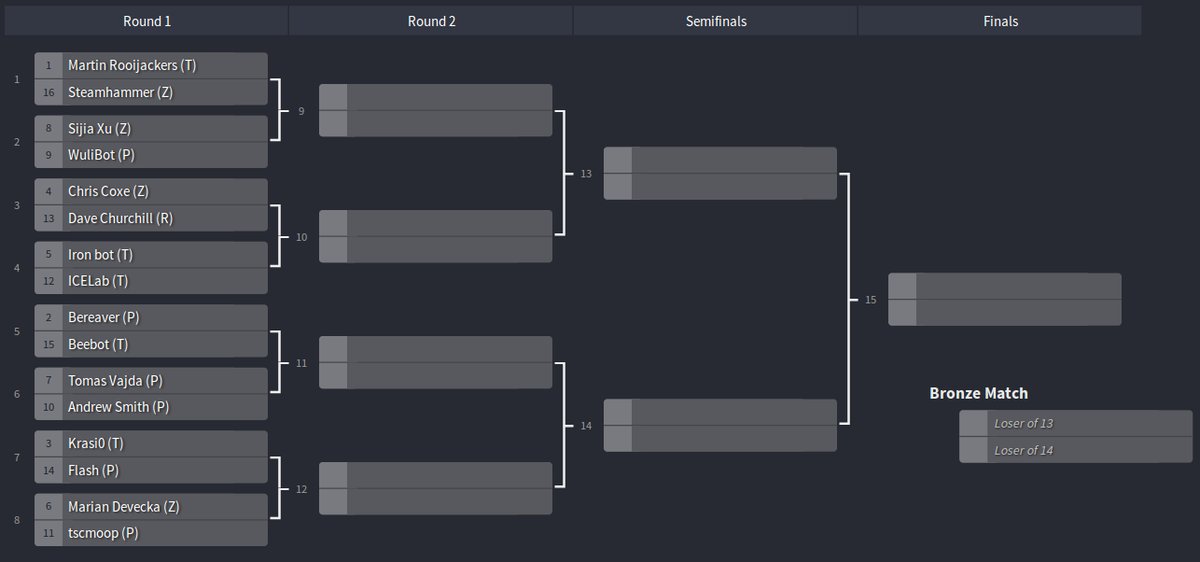
Steamhammer will play LetaBot in the round of 16. The pairings are 1-16, 2-15 and so on, the arrangement with the least likelihood of upsets for the top finishers. Nevertheless, Steamhammer does defeat LetaBot occasionally and has a small chance to move on to the round of 8. If Steamhammer pulls off the upset, it will almost surely lose in the round of 8—it loses 100% against Wuli’s 9-9 gate zealot rush, and nearly as often against Overkill by Sijia Xu. I’ll borrow the bracket image.

SSCAIT 2016 finals bracket

Steamhammer and the SSCAIT finals

The round robin phase of SSCAIT 2016 has just finished. Seconds ago, Matej Istenik beat OpprimoBot in the last remaining game. Did Steamhammer make it into the round of 16?

It was a nailbiter! Only fiction gives us closer decisions. As the end approached, Steamhammer and Zia were tied for 16-17th places, each with 1 game remaining to be played. One would be in and one out! As the last dozen or so games came up, Zia was scheduled to play MegaBot, and after 2 intervening games—just enough time to enjoy the tension—Steamhammer to play Tscmoo protoss.

Zia had beaten MegaBot in their previous game, and easily won again. In the previous Steamhammer-Tscmoo game, Tscmoo had opened forge expand; Steamhammer did not know how to adapt its build and lost. (That is why Steamhammer opens three hatch before pool against XIMP and ZerGreenBot.) Tscmoo is unpredictable.... I thought the odds were poor, but I knew anything was possible. This game Tscmoo opened 14 nexus and then gas before gateway, a crazy greedy opening, and went down like a house of cards. What a way to deflate expectations of an exciting decision!

Steamhammer and Zia finished in a tie for 16-17th places. I don’t know how tiebreaking will work. Their result against each other was (I’m sure you already guessed this) 1-1, so that doesn’t help. Maybe they’ll have a playoff game. Either way, I’ll enjoy watching the finals and I’m happy that my bot performed so well after such a short development time. Watch out for the next version!

Next: Some of the bugs that came up in the round robin phase.

win ruthlessly like LetaBot and ZZZKBot

One of the stories of SSCAIT 2016 is that LetaBot (playing under its author’s name, Martin Rooijackers) scored easy wins over certain tough opponents with SCV rushes. Classic LetaBot used to play bunker rushes and recent LetaBot versions still sometimes performed SCV-marine rushes, so the rush opening should not have been a total surprise. But it worked perfectly against Krasi0 and even against micro-virtuoso Iron. The losers tried hard to keep their own SCVs safe, lost too much mining time, and could not keep up.

I approve. That’s the way to do it. If you find a weakness, exploit it ruthlessly and don’t worry about whether people look down on you as a cheeser. In fact, that is ZZZKBot’s entire modus operandi, and ZZZKBot is doing well with it, departing from its traditional 4 pool often and effectively with opponent-specific builds. Ruthless wins are your opponent’s way of telling you what you need to fix, and that’s good for everybody.

LetaBot’s rush looked similar to the rush we used to see from Stone, before Stone evolved into Iron. LetaBot pulled back its damaged SCVs into loving mutual-repair couples before returning them to the fray. I rather wish Stone were still playing alongside Iron. Stone would constantly remind other bot authors of the importance of good worker micro—worker micro is difficult (and I sure haven’t gotten around to it in Steamhammer), but it’s key.

don’t lose that scout

Wow, it’s down to the wire on whether Steamhammer will make it into the final 16. Steamhammer has been scoring a little lower in the final third of the tournament, and as I write it is standing on the edge at rank 16. With 10 games left, I look at the opponents and expect 4 losses and 6 wins, probably not enough to hold rank 16.

But we don’t know until we know. In an unexpected loss to PeregrineBot (which it easily beat in their first game), Steamhammer suffered at least 2 different play bugs, including one caused by losing its initial scout before finding the enemy base. Gotta fix more bugs. Then it followed up with an unexpected win against Bereaver; the protoss had easily won the first game. Bereaver was careless with its early probe scout and lost it before zerglings spawned, and Steamhammer’s aggressive play caught it off guard. Without information on what zerg was doing, Bereaver did not make enough zealots to hold. Moral: That scout is important!

We’ll see what happens! Steamhammer plays sharply and is prone to upsets in both directions.