archive by month
Skip to content

Snow-Sharp compared to Locutus-Krasi0

Here’s a recent pro game Snow (P) - Sharp (T), in which Sharp expanded behind a bunker somewhat like Krasi0, while Snow repeatedly ran by the bunker with dragoons much like Locutus. The game was played in KSL season 1 in group B on 3 August.

A point to note is that Snow tried to keep 3 dragoons inside the terran base. When the count fell below 3, it was time for another runby. 3 dragoons can kill an SCV in 2 volleys, or a tank in 3 volleys, so 3 dragoons are much more powerful than 2. (Versus a tank you’d prefer 4 dragoons which kill in 2 volleys, but with only 2 dragoons it takes 4 volleys—3 dragoons was the right number for this specific situation.) Also, Snow camped the single factory with the dragoons and felt no need to seek out other targets. Everything dangerous was going to come out of the factory, and if you can stop production, you win. Terran was forced to defend there.

Games like this remind me how far we have to go. It was so similar to a bot game in some ways, and so different in others. Compared to Locutus and Krasi0, the human players knew better what they needed to do, and were much better at coordinating their units to do it.

why Steamhammer needs a tactical analyzer

This picture of Steamhammer versus XIMP by Tomas Vajda is a perfect illustration of why Steamhammer needs a smarter tactical analyzer.

Steamhammer retreats into the enemy defenses

The hydras decided that they had to retreat from the carriers at the top. Where to retreat to? “Hey, look, those scourge have found a great location! It’s a safe spot, it’s close to the enemy base—let’s go there!” It follows a heuristic of trying to keep its units together. It hardly needs saying that the entire hydra force was lost trying to run past the cannons. In big army games, Steamhammer makes similar blunders nearly every game.

The poor scourge play is another issue....

The picture also illustrates the silver lining to Steamhammer’s excessive retreating weakness in this version. Because Steamhammer now plays weakly when it is locally behind, it lost games playing the merely strong 3 hatch hydra opening that it had settled on in the previous version. It was forced to find an even stronger counter to XIMP, 3 hatch before pool into hydras. Look at the worker counts—even after losing this army, zerg is still ahead because its massive economy can replace the losses while protoss will remain unable to expand. Thanks more to XIMP’s objectively bad strategy than to Steamhammer’s play, and despite the severe blunder, Steamhammer put the game away easily.

Randomhammer-ZurZurZur game with vulture-wraith opening

Randomhammer terran played its first public game with the vulture-wraith opening against zerg ZurZurZur. As I have mentioned, I wrote vulture-wraith originally as an extra test of Steamhammer’s anti-factory zerg opening. I found that the vultures and wraiths bring terror to unprepared zergs, so I made it a permanent part of the terran arsenal.

ZurZurZur, it turned out, was not prepared at all. It could not get a sunken colony up, and it did not get hydralisks into the fight until its natural was destroyed. By then it had lost all overlords so it could not reinforce and the hydras were quickly defeated. I can see how Tscmoo terran does so well with a similar strategy.

ZurZurZur loses its natural

I’m working on zerg stuff now for the upcoming tournaments, but I have a note to revisit this opening. It shows its legacy as a test opening; the execution and followup could be much stronger.

Next: A latent bug.

Hao Pan’s bunker rush

Hao Pan has started to play a cheese opening: Barracks in the center of the map at 6 supply, followed by a bunker at the enemy base, usually near the entrance. Many bots seem unready for the trick and react poorly. Krasi0 has been losing games. Bereaver stopped the bunker with skillful probe micro, but then forgot to make gateway units and suffered for it.

If the bunker fails, then Hao Pan’s marines will scatter and try to lure the enemy units all over the map like the Pied Piper. Most bots fall for it, including Steamhammer and forks. The game Hao Pan-Antiga is entertaining to the end.

LetaBot used to play a similar opening, though not with the strong basics of an Iron fork. There are still new cheeses to try, and old ones to improve on, and every time somebody does it, they catch unsuspecting victims. I have some cheesy ideas in mind; maybe I’ll get one ready in time for AIIDE.

confused game Steamhammer-Tyr

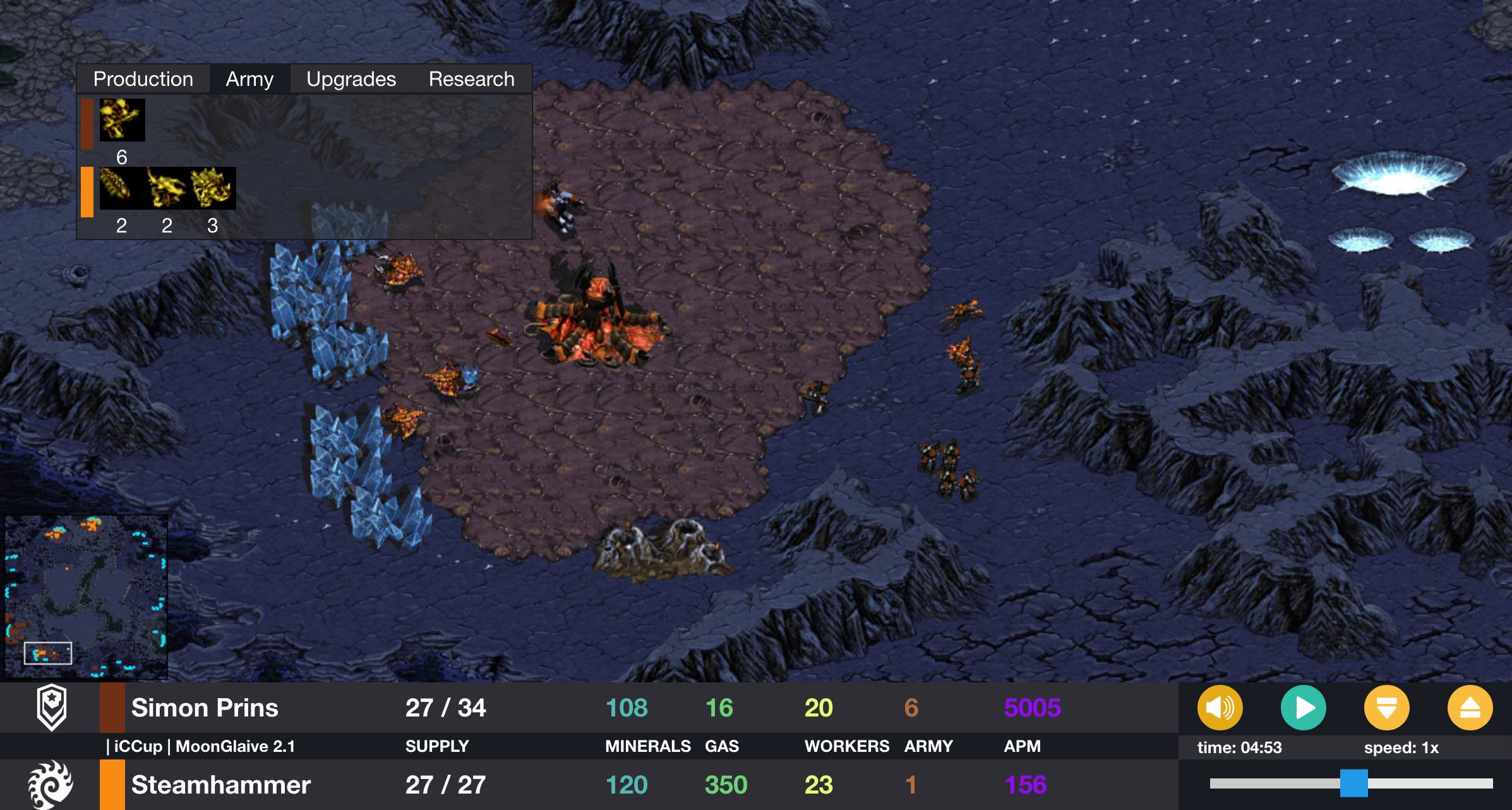
Steamhammer and Tyr terran by Simon Prins played a hilarious game on Moon Glaive. I think that Steamhammer decided on a 3 hatchery before spawning pool build (it’s not entirely clear), but the zerg build became confused because Tyr’s scouting SCV delayed the natural hatchery, and because Steamhammer has an issue on this map where it sometimes sets its bases down unexpectedly far away. The build as executed was hatchery-pool-hatchery, with the third hatchery in Tyr’s natural because zerg hadn’t located the enemy yet. Something similar happened almost exactly a year ago in a game versus Krasi0.

Tyr reacted differently than Krasi0: Tyr ignored the zerg base in its natural!

Tyr is unworried by the zerg base

The marines fired at the zerglings, but the hatchery and drones were in plain sight, and they just didn’t care. Their job, I gather, was to guard the natural against zerg attack, and the functioning zerg base was not an attack. They took their orders literally! Steamhammer was also unworried, and mined minerals contentedly.

Tyr was bright enough to figure out that it had to expand somewhere else, and planted a command center at what would normally be its 3rd base position. The zerg play was disorganized, but the terran play was more disorganized, and Steamhammer won effortlessly.

Microwave beats Iron

Locutus is doing great. What I find more interesting is that Microwave is also doing great since its update yesterday. In particular, Microwave seems to have improved enough to beat Iron consistently. I thought the most interesting game was the most recent one.

Furthermore, Microwave played more than one opening against Iron in its recent winning streak. Its favorite, though, seems to be 9 pool with a fast 2nd hatchery. The game plan has not changed much, only the execution is improved. Early zerglings hammer on the terran wall, occasionally breaking it down but usually only sapping the terran income. The lings don’t care if the wall is open, or if they come under fire, they only want to hit those supply depots. Microwave defends against the vulture runby with sunkens up front plus a sunken in the main. Iron usually appears surprised by the sunken in the main and fails to cope with it. Microwave follows up with hydralisks and later mutalisks, switching flexibly between hydras and mutas and preventing Iron from gathering its forces—especially targeting tanks so that they don’t build up to large numbers. Eventually Microwave reaches a critical mass of hydras and wins.

Even if you are as good as Iron, that is what happens if you always play the same and don’t update for a long time.

Locutus and Microwave are both Steamhammer forks. I’m pleased that they’re doing well. I see it as partly my success, too.

Steamhammer-PurpleWave game

Steamhammer has played another good game against PurpleWave. This seems to happen regularly. See Steamhammer-PurpleWave games for a few older games (which are not as good as this one).

I don’t want to do the blow-by-blow for this game, but here’s a little of the story. 2 games ago, PurpleWave played its worker rush against Steamhammer and won. 1 game ago, Steamhammer countered the worker rush and, partly because the map was more favorable, held it off to win. PurpleWave’s worker attacks are coordinated and Steamhammer’s worker defense is not, so PurpleWave can often win even when Steamhammer plays an ideal counter build. Anyway, having lost, PurpleWave switched to its forge expand opening. Strategically, it’s the opposite of a worker rush.

Steamhammer continued to counter the opening of the previous game, and played its anti-worker rush build. It’s a cautious opening that expects cheese, and it goes so far as to make a sunken colony. It’s the opposite of how you want to play against a big economy build like forge expand. So, after an early fight where Steamhammer didn’t quite figure out how to exploit PurpleWave’s poor cannon placement, zerg was behind.

I want to make 2 points about the game. 1. Steamhammer’s ZvP is much improved. When PurpleWave moved out with its big army, zerg was still behind. Steamhammer put up a fierce fight and eventually wore down the attack and held, losing some drones but not enough to die. And zerg continued to play well after that. Earlier versions won the big fights only when PurpleWave overextended, which did not happen here—thank economy improvements. And earlier versions did not follow up as nicely after the big fight—thank tech improvements.

Point 2. Near the end of the game, Steamhammer expanded to a mined-out base. :-( This version was supposed to fix the last way that that could happen. There is a bug in choosing the base to expand to. I am walking the Path of Bugs and the path continues over the horizon.

close game Steamhammer-LetaBot

I don’t want to write up any games that might be from the SSCAIT elimination phase, since it wouldn’t be polite to scoop the official announcement. But there are some good ones. In particular, CherryPi is starting to show its full opponent modeling skills, which are more sophisticated than we could see in the round robin phase with only 2 games against each opponent.

So here is a close game from the round robin, Steamhammer versus LetaBot by Martin Rooijackers. Steamhammer randomly chose a 1-hatchery lurker rush, a risky opening which often beats LetaBot quickly. This time, Steamhammer got distracted chasing the scouting SCV and put on no pressure with its early zerglings, allowing LetaBot to bunker safely at the front of its natural instead of in its main. Often LetaBot overreacts to the threat of the early zerglings, which is actually slight, and leaves itself weak to the lurkers. Here it defended nicely.

marines and blood

Well, not quite nicely. A bunch of marines stood in front of the defenses and were slaughtered by lurkers outside detection range of the turret. But Steamhammer is no smarter. As soon as the way to the bunkers was clear, zerg became overaggressive with the lurkers and lost them quickly. One lurker stayed outside bunker range and drained terran minerals into repair for a while, but as soon as marine range research finished in the academy, it died too. Steamhammer had rushed to lurkers with a weak economy (see the worker counts in the picture), so after an even-ish combat outcome, terran was ahead.

Followup lurkers behaved the same, killing infantry that placed itself needlessly in danger, then placing themselves needlessly in danger and dying. LetaBot expanded much later than it should have, letting zerg catch up in economy. But Steamhammer had been frittering its army away while LetaBot continued to build up despite losses, so terran was still ahead.

Finally the terran push came. The 4 sunkens and small zerg force can only delay the inevitable; the natural will definitely be lost. Zerg has 4 bases and an adequate economy, so it can attack the terran ball from all sides, but chances to save the game seen small.

the natural about to come under siege

The rear-placed sunkens were highly effective, because LetaBot assaulted them without regard to losses. Marines funneled between the buildings, suffering both sunken hits and splash damage from tank fire. Scattered zerglings ran in from every direction, but SCVs kept the tanks repaired. Steamhammer kept sending more drones to mine the natural gas, while LetaBot had expanded and added to its SCV count, so zerg was falling behind in economy again.

A small number of terran reinforcements were intercepted by zerglings taking a strange path across the map. The terran attack started to become disorganized, with some units running into the zerg main before the natural was reduced. In the picture, the spread-out tanks are under attack from both ends, and in the minimap is an engagement between zerglings and reinforcing marines, preventing the marines from joining up promptly.

terran is disorganized

The zerg army remained tiny, but it was LetaBot’s turn to rush in pell-mell without organizing its forces. Without marines supporting the tanks, and with adrenal gland research finished to increase the zergling attack rate, the small number of zerglings finished them off easily.

With the slow-to-replace tank mass destroyed, Steamhammer had enough forces to stop any followup attacks. The turnabout was sudden. Zerglings broke into the terran natural while the double bunkers were unoccupied, and simultaneously 1 lurker and a handful of zerglings erased the terran third. There was a little more drama with a last-ditch battlecruiser as Steamhammer was slow to deliver the finishing blow, but in the end an unnecessarily massive zerg force battered down the undefended terran buildings.

It was another narrow comeback. Those make fun games.

Next: Analysis of solid versus daring bots.

two McRave games

Here are 2 McRave games. The first is what will probably turn out to be the biggest upset of SSCAIT 2017, and for journalistic balance (look at me! I can pretend to be objective, just like a reporter!) the second is a win over a tough opponent that has given McRave trouble.

McRave is currently at #3, and it will probably finish there. So I find it striking that both games show easy to notice weaknesses on both sides. All bots have a long way to go to become truly strong.

McRave-FTTankTER

As I write, McRave is #3 and FTTankTER is #69 out of 78 entrants, with fewer than 50 games remaining to play in the tournament. There are a couple of unplayed games that theoretically could unseat this one as the biggest upset, but it’s unlikely. What I find most remarkable about the game is not that the result was such a reversal, but that it came about because FTTankTER played better. McRave didn’t lose because of a bug (at least not one that I can detect) or by playing a risky strategy and getting unlucky, but because of missing skills.

McRave-FTTankTER started with McRave fast expanding behind a single gateway and FTTankTER rushing with marines.

marines arrive at the front

McRave did not make an initial zealot, but waited for its cyber core to finish so it could get straight to dragoons, the key unit at the start in PvT. Making 1 zealot slows down dragoons a trifle but adds safety against all kinds of cheeses and fast rushes, so it’s probably smart. But even without, McRave could have held. When a small number of marines show up at your front, they are weak. Marines gain strength in numbers because they are ranged units, but workers are faster and tougher than marines without medics or stim. Just pull workers and defend until your gateways produce. Workers can easily win fights against small numbers.

Instead, this happened:

Protoss pulled probes only after losing its first gateway, when the marine numbers had grown. The probes did not try to surround marines, but mostly milled around in front of the marines as if playing dodgeball. Nearly every probe was lost before the dragoon entered the fight. McRave was too optimistic, first in ignoring the attack, and then in continuing to throw away probes. A fallback plan would be: Abandon the natural, retreat the surviving probes, wait for the dragoon, and try a coordinated probe-dragoon defense of the main.

FTTankTER is clumsy and wasn’t able to finish off its helpless opponent, but the no-kill time limit ran out and terran won on points.

I think McRave shows some wider vulnerability to marine all-in attacks. McRave-Oleg Ostroumov is an example. Since McRave has lost fewer than 10% of its games, its weaknesses are apparently not easy to exploit.

McRave-CherryPi

CherryPi won its first game over McRave when McRave played a standard forge expand. In the second game, McRave played differently and CherryPi never seemed to notice. It was still a fight, though.

When both players learn, it becomes a race to see who can learn more and faster. With only 2 games, we can’t tell how the race would have turned out.

The game McRave-CherryPi on Benzene opened with McRave building 2 gates and CherryPi playing overpool into second and third hatcheries at the natural. CherryPi droned up as if McRave had fast expanded, which it should have known didn’t happen because its zerglings made it to the protoss natural. Zerg was underdefended, and McRave’s zealots killed a couple drones in the zerg natural and started hitting buildings.

Then a sunken started and the zealots retreated for no apparent reason. Protoss should at least take swipes at the morphing sunken until zerglings appear. The protoss scout probe in the main saw the zergling count and location, so McRave could have known it was safe. In the game above, McRave was overconfident; here it is overcautious. It is a sign of not truly understanding the situation (so far, no bot does). In the picture, the zealots have just retreated.

protoss retreats unnecessarily

Wuli beat CherryPi 2-0 with its heavy rush, but McRave likes to tech faster. CherryPi added to 3 sunkens and continued drone production, still seeming to assume that McRave had fast expanded. McRave poked repeatedly at the front without committing much or achieving much; at least it impelled zerg to spend on fighting units instead of drones. McRave often had a vanguard of units doing the combat and a rear guard that stayed out of the fight. I got the impression that McRave was not hiding its strength, but was just confused.

CherryPi had mismanaged the opening and was contained. Lurkers or mutalisks might have forced protoss back, but CherryPi got the lair late and did not make either; it wants to win with low-tier units. Sticking with zerglings and hydralisks and making many drones, zerg soon needed to expand more than it safely could, and put a hatchery at the nearby mineral only base, barely outside the containment. McRave soon scouted it—and did nothing. Protoss continued to poke at the front and ignored the third base. It could have detached a couple of rear guard zealots to take it down; zerg could have done nothing. The picture shows protoss defeating an inadvisable zerg foray near the mineral only third. After this, McRave ignored the third and made another poke at the front (even if the bot doesn’t notice creep, protoss had seen the hatchery with a probe). In the minimap, McRave has just started its natural nexus.

smashing a zerg escape attempt

Finally McRave felt confident enough to split its forces and kill the expansion. Before it died, CherryPi started a fourth base in the lower right corner. CherryPi was ahead in workers but had only 2 mining bases, while McRave had a far stronger army and a mostly successful containment (it only leaked a few drones).

After finishing the zerg third, McRave seemed to realize how far ahead it was and broke into the natural. With drones killed and a second nexus to make more probes, McRave had effectively caught up in economy and its army was more than zerg could face. In the picture, a high templar is storming drones that decided to fight instead of running away. The drones might as well do that; the only place they could safely run away to was the main, which was already saturated.

storming drones

CherryPi did not go down easy, but protoss was too far ahead. Oddly, though McRave made many templar and they accumulated plenty of energy, that one storm was the only one in the game. The high templar stayed in the rear guard where they were too far away to contribute. Also, both bots seemed confused by the neutral building block on the map, and got units stuck behind the block. I expect that from rough bots like Steamhammer, not from polished competitors.

CherryPi showed its curious strategic rigidity, where it believes without scouting that it knows what the opponent is doing—in this case, it even scouted that the opponent was not doing what the zerg opening assumed. To me it seems strange, because in Steamhammer the first major feature I wrote was the strategy boss which solves this exact problem, and it greatly boosted zerg’s strength. McRave showed surprising caution and slowness in taking advantage of opportunities.

cheese game McRave-MadMix

Yesterday an epic, today a short sharp shock. The game McRave vs. MadMix is a brazen cheese. Why shouldn’t I build my first pylon next to your nexus? Maybe because it couldn’t possibly succeed?

MadMix placed its first pylon in McRave’s mineral line, at the corner of the nexus. I can suggest an improvement: Place the pylon slightly to the left so it blocks access to the indented mineral patch. That is called a manner pylon because it is ever so polite. A probe sent to mine there will run behind the mineral line, slowing down the opponent’s mining. If you’re going to push a pylon into the opponent’s face, you might as well make it a manner pylon, as in the famous game Bisu-Pokju from 2007.

A manner pylon is commonly worth it, given that you have an early probe in the opponent’s base, especially if (as in Bisu-Pokju) it blocks 2 mineral patches: In between trapped workers that have to escape (which I doubt bots have the knowledge to do), workers devoted to attacking the pylon, and workers sent behind the mineral line, it can slow down the opponent’s mining more than enough to make up for its cost. It occurs to me that a bot with mineral locking could avoid some of the cost provided it has the special case knowledge to avoid locking workers to the blocked mineral patch or patches. I doubt that any bot has that knowledge yet, since I’ve never seen a bot place a manner pylon! I would be interested to see how a manner pylon interacts with LetaBot’s path smoothing. If the smoothing is not smart enough, some SCVs might be unable to mine at all—I am imagining SCVs bumping against the pylon trying to follow the shortest path.

one pylon for each side

McRave assigned 2 probes to tear down the offending pylon. MadMix calmly continued the cheesemaking process, building a gateway, then replacing the destroyed pylon with 2 fresh pylons, then laying down a second gateway, all while sending fresh probes to make sure one was always on hand. McRave seemed unimpressed and carried on with its 1 gateway build.

2 gates versus 1 gate

McRave ought to have been impressed. McRave’s first zealot was out earlier, and it could have held easily with good play. But McRave didn’t seem to know how to react; as it was attacking proxy buildings and mining gas and starting its cyber core, MadMix was killing probes and pulling ahead. The proxy won. Correct play when you get proxied like this is to delay your tech until you have the situation in hand. Your opponent set itself back to perform the proxy, and you can always stay ahead in units.

Don’t blame McRave for missing knowledge. All the top bots, Iron and Tscmoo included, have knowledge gaps wide enough to drive a government cheese truck through. It was only shortly before the tournament that I added smarts to Steamhammer to react on the fly to this kind of in-base cheese (Steamhammer makes a spawning pool if it has 9 or more drones, and will cancel gas or a second hatchery if that helps it get the pool up faster). And Steamhammer doesn’t understand how to react to other proxies like Juno’s (by Yuanheng Zhu) cannon contain (it still relies on a hand-coded counter for that). Bots need a lot of knowledge and it takes a long time to acquire.

epic game Steamhammer-WOPR

Today’s game is Steamhammer vs. WOPR by Soeren Klett on Andromeda. The game is not only epically long, it is epically clumsy on both sides.

WOPR plays a mech strategy that is slow with air defense. When Steamhammer opens with mutalisks, it flicks WOPR aside. This game, Steamhammer randomly chose to open with a low-economy lurker rush, and momentum went the opposite direction. WOPR had just enough scans to stop the initial lurker attack (a cleverer or more persistent attack might have succeeded). Then zerg strangely decided that its next tech choice should be hydralisks. Steamhammer had seen enough tanks that it should have known it was making a bad decision, so I think the error was not in analyzing the unit mix, but in choosing the tech target based on the analysis. Yesterday I rewrote StrategyBossZerg::chooseTechTarget() in a way that fixes 2 subtle bugs and improves the intended behavior, and I hope that will solve the problem. Anyway, WOPR eventually went on campaign and wiped out the zerg natural and main and the in-base mineral only, while cementing its huge lead by expanding across half the map. All that was left was to clean up a few underpopulated zerg expansions.

In the picture, the zerg economy remains weak and the army is hopelessly outmatched because it has suffered continual losses due to poor unit mix and poor tactics. In a human game, zerg could give up. 2 new terran expansions are visible on the minimap. Also notice that there are 3 evo chambers even though Steamhammer only knows how to upgrade with 2—it’s another bug that I fixed recently.

Steamhammer is about to get crushed

Like many old-school bots, WOPR believes it is finished when it has destroyed the enemy main. It does not seek out remaining bases, but sends its army toward (0,0) in the upper left. But WOPR does move its army to react to enemy units that it sees, and it continues to take bases and defend itself. Terran was maxed and zerg was extremely weak, with 8 surviving drones and the only tech a spire built at the last minute before the hive was destroyed. In the minimap, red is everywhere and blue survives in a corner. (Light blue on the minimap represents neutral buildings.)

Steamhammer has been crushed

Steamhammer knows how to recover. It slowly rebuilt its economy and tech and made mostly air units, especially scourge since it had seen battlecruisers. When the few zerg units showed themselves, an overwhelmingly strong column of terran units appeared and chased them away. Even constrained to ignore the zerg bases, terran had a big advantage. If zerg built up fully and also maxed its army, terran still had more bases and had been banking resources for a long time. WOPR only had to hold firm until the time limit was reached, and it would be awarded victory on points.

terran chases zerg off

After the above picture, the battle started to get interesting. The scourge scored more victories than losses against the battlecruisers and cloaked wraiths. The first ultralisks were annihilated by tanks with +3 attack, but zerg was starting to do some damage. Of course WOPR had a huge reserve of minerals and gas, and it instantly replaced lost units. But then zerglings and one ultralisk found their way into the terran 9 o’clock base and destroyed it before it had quite mined out. Terran forces had been distracted by air activity at the center base, and most of the terran army remained guarding the unimportant upper left. It looked as though zerg had a chance after all; WOPR’s tactical reactions were not accurate enough. Notice the zerg supply continuing to increase. WOPR replaced many of its lost workers with combat units, which was correct play because terran had a big bank and didn’t need the income.

zerg destroys a terran base

Steamhammer attacked the upper left natural and didn’t quite finish it off. Then the ray of hope started to dim. Steamhammer made too many guardians and was in danger of losing them all to the battlecruisers. Then hope brightened: WOPR played poorly and Steamhammer had the sense to follow up with hydralisks and scourge, and the battlecruisers exploded. WOPR targeted hydralisks though battlecruisers can one-shot the more dangerous scourge. Zerg destroyed the upper left natural. Then hope dimmed again: Steamhammer decided that the next target had to be, not an undefended base, but the upper left main where the giant terran army was hanging out. In the picture, the zerg army could not even get close before it was forced back by terran reinforcements appearing to its rear. Still, notice that zerg has retaken its main and mineral only and is now taking the formerly terran upper left natural. WOPR retook 9 o’clock and finished mining it out, but was otherwise not as economically active as it should have been. The zerg economy was in high gear and zerg was ahead in minerals but hurting for gas.

zerg chooses a hard nut to crack

Both sides showed messy tactics and micro. Steamhammer made a few devourers for help against the battlecruisers and wraiths, but used them poorly. Zerg lost workers after taking the indefensible center base (which it had earlier kicked out of terran hands). Steamhammer also made many indecisive movements and often chose the wrong targets. WOPR played worse, though. It kept the goliaths in the corner surrounded by siege tanks, so the massive air defense was out of range of attacking guardians. Guardians slowly ate through the rows of tanks and finally killed the command center. Hydralisks, despite some confused behavior, kept terran reinforcements at bay though they couldn’t approach the mass of tanks.

WOPR plays worse and zerg starts to win

Having killed the upper left command center, Steamhammer felt no need to engage the remaining terran army but set about the task of clearing the other terran bases. At least that part worked well. WOPR was less efficient and burned through its entire bank of minerals. Steamhammer won without ever maxing its army.

It was 46 minutes and full of events, many of which I didn’t mention. As one example, you can see on the minimap in the last couple pictures that Steamhammer built 2 macro hatcheries in a strange position outside its original base, where WOPR had taken the natural. I’m not sure what caused that.

By the way, this is the kind of game where either player would have benefited from being able to take island bases. If Steamhammer knew how to take islands, it could have made 2 more bases and would have recovered faster. If WOPR took islands and turreted them up, they could have been defended indefinitely by air units. To destroy a strongly defended island base you need a coordinated large-scale attack which no bot has the skills to pull off.

Bryan Weber is fearless

Bryan Weber has no fear of building a hatchery in the face of the enemy. Bryan Weber - CerkoBot by Thomas Cere has an example that I couldn’t resist. Notice the one drone calmly mining minerals in the midst of a crowd of probes and surrounded by battle.

Bryan Weber wants this base too

Bryan Weber - NUS Bot has a less extreme example, merely building next to the enemy main. This hatchery did not live long, despite the lurker that hatched and defended it.

seems like the spot for a macro hatchery

There are more.

entertaining Steamhammer game

MadMix protoss lived up to its name and went to 4 bases before its first gateway against Steamhammer. You can’t beat Steamhammer that way, but you may make a very entertaining game!

Actually it would have been a short and boring game if Steamhammer opened with one of its mass zergling openings, as it often does. But Steamhammer went macro style, with 12 hatch 13 pool (squeezing out extra drones early) aiming for hydralisks. Also Steamhammer didn’t understand that the enemy had gone overboard and should be drowned for it (it’s an easy adaptation to code but not needed because Steamhammer wins those games anyway). Zerg thought, logically enough, “That’s a lot of bases, I’d better make a ton of drones to keep up!”

Steamhammer wants more drones

Steamhammer still made enough units to keep the pressure on and repeatedly kill probes. It didn’t take many; 4 bases before gateway is amazingly reckless. Despite concentrating on drone production, zerg was never in trouble.

protoss barely has an army

Finally Steamhammer reached its goal of 75 drones and army production turned on full. The fury of the swarm swept away the fragments of the protoss bases.

fury of the swarm

Against TyrProtoss, Steamhammer played the same hydralisk opening. Despite playing on its worst map and messing up its macro, Steamhammer had (as I expected) an almost adequate army and held a chance to stop the big timing attack. Instead (as I also expected) it decided to move its forces through the enemy army without fighting and lose everything for nothing—the weakness is related to paths on the map. Steamhammer still makes many fatal blunders in big army fights.

Against ZurZurZur, Steamhammer got in trouble but managed to slowly claw ahead with better decisions. This could be an instructive ZvZ to study, with mistakes all around and all through.

igjbot

Zerg igjbot is new today on SSCAIT. It has been crashing a ton, but when it plays successfully it shows a thoughtful design.

Igjbot seems to follow the same plan every game. It opens with a standard 9 pool speed build that is safe against rushes and puts on early pressure (or kills weak opponents outright). It doesn’t follow up with heavy zerglings, but goes for a quick spire. An opponent that is too worried about the zerglings is at risk from the sudden air attack. But igjbot doesn’t press the air attack heavily, either. It adds to 3 hatcheries and switches back to mostly zergling production. The specific build order is efficient, at least early in the game (later on it collects more gas than it can use).

I thought igjbot’s most impressive game so far was versus Krasi0. Krasi0 did not seem ready for the fast mutalisks—it was still constructing its engineering bay when the first mutalisk arrived, and canceled it when the mutalisk attacked the unfinished building. As more mutalisks arrived, Krasi0 had to use all its defensive skill to put out the fires in its base and stay alive. Terran won, but had to struggle for it! In the picture, besides the burning buildings, notice the marks of canceled and destroyed buildings, and also the worker and army numbers.

Krasi0 frantically defends

For a brand new bot that wants to get by with 1 build against all races and opponents, I like igjbot’s game plan. It is safe against early aggression, it tends to force opponents into defense, and it tries to whipsaw the opponent with a tech switch and then a switch back. It’s not boring like another 5 pool bot. It’s a simple plan that is suitable for most situations and demands more from the opponent than from igjbot, and that’s perfect if you’re starting out and haven’t gotten far. Igjbot has micro weaknesses, no ability to expand, and other common problems, but those things take time and a new bot hasn’t had time yet. With smart strategy, it can still do fairly well.

Randomhammer’s marines versus protoss

This game Randomhammer-MegaBot 2017 is an example of why it’s not such a good idea to go marines versus protoss. Randomhammer still does it (15% of the time in the live version) because its other TvP strategies are also ineffective.

Stage 1: MegaBot went 2 gate zealots while Randomhammer answered with marines from 2 barracks. If MegaBot had been aggressive with the zealots it likely would have won early, because Randomhammer doesn’t understand early game marine-zealot micro and it lets the marines get hit far too often. But MegaBot did not press. In the picture, the larger zealot army is overcautiously retreating.

MegaBot retreats for no reason

Stage 2: Randomhammer got academy tech while MegaBot was still on zealots. The terran force had been dangerously small because of poor macro, but it was growing. Then the zealots took a bad engagement moving across a bridge in widely separated formation, and got wiped out. Stim is strong, and slow zealots are not the right unit to face marines and medics.

Randomhammer annihilates zealots

Stage 3: MegaBot got dragoons, which it should have done much earlier. Defending the ramp, a small number of dragoons was just able to hold the infantry force that had destroyed far more zealots. The better tactical situation (defending a choke instead of trying to pass through a choke) and better unit choice of dragoons versus marines made a huge difference.

MegaBot narrowly holds its ramp

Stage 4: MegaBot expanded and formed a mixed army of dragoons and zealots. Randomhammer built factories for tanks and also expanded but lost the command center to dragoons. It was partly due to more weak macro (gotta replace BOSS).

The game went on because MegaBot decided not to win on the spot, but morally Randomhammer was lost. In the end, though, MegaBot crashed. The game is also an example of the importance of reliability.

I chose the game to write up because of the stark contrasts between stages. The zealots seemed strong at first, then went poof after stim finished. A trickle of dragoons in the next stage was enough to turn it around again. The game would have been a better example if MegaBot had gotten reavers or storm and showed the infantry some real protoss devastation.