archive by month
Skip to content

Steamhammer-BananaBrain roller coaster game

Steamhammer versus BananaBrain on Moon Glaive was a fun back-and-forth game. Well, it was Randomhammer as zerg, that’s Steamhammer.

Steamhammer opened with a fast hatchery before pool, preparing zergling aggression. BananaBrain was also aggressive; it hid 2 gateways on the left of the map where they were unlikely to be scouted early. The gateways were more or less midway by ground between the 2 bases where zerg might be.

hidden gateways

The zerglings outfought the zealots, then made a beeline for the protoss base, where they wrecked the economy. Protoss was left with 1 probe mining and 1 more in production.

probe massacre

But protoss had still been producing army during the attack, though the units were too far away to defend the main. It’s the drawback of a proxy opening: Close to the enemy means far from home. Steamhammer did not see the units and concluded that it was safe, so it started a third base (see 8 o’clock in the minimap), added a hydralisk den, and morphed a lair in its natural. A good human player would have predicted the protoss army size and been ready for it, but bots to date are weak at inference. Steamhammer could not save the lair in its natural and threw away units trying, then pulled together a defense in its main barely in time. BananaBrain ran by the sunkens to attack drones, one of its great skills, and it was zerg’s turn to fall behind in economy. Notice how much the protoss probe count has recovered. The zerg drone count fell to 5 shortly after the picture.

drone massacre

Three drones escaped the carnage and ran across the map to the hidden zerg third, which protoss did not yet know about (though a human player would have guessed its general location from the direction of arriving units). After a short distraction when a small zerg squad again attacked the protoss main, BananaBrain put heavy pressure on the defended zerg main. Both sides were racing to rebuild workers and trying to afford tech.

dragoon attack on sunkens

It was around here when BananaBrain repeatedly tried to expand, and Steamhammer’s patrolling Recon squad repeatedly denied it with only a few units. Protoss chose to keep attacking rather than defend an expansion. BananaBrain has added tech and sent out corsairs, and zerg protected its overlords with a spore colony in the main. Steamhammer’s mineral bank of 900 is a sign that it is short of hatcheries—it knows that, and wants to add hatcheries.

stopping the nexus

Needing more hatcheries, Steamhammer also tried to expand, in a rather strange pattern where the first hatchery at a new base was offset and the second one placed at the base location. The natural was denied, then a new base at 10 o’clock was about to be killed by zealots—when a scouting observer finally ran down the left of the map and discovered the hidden base, now bustling with drones. The protoss army suddenly had a more alluring target, and ran there to raze it.

losing the hidden base

But Steamhammer had mined its third base for most of the game, and BananaBrain had never been able to expand. The protoss main was dry, and the zerg 10 o’clock now had a half dozen drones at work, and it shows in the production tab. Steamhammer scourged the sky of corsairs, defeated the zealots with hydra-ling and a few mutalisks, and tore down the proxy gates before finally tackling the protoss main.

protoss defeat

Whew, no big fights because of the damaged economies, but an exhausting struggle. Either side could have won easily at various points with smarter play at that moment.

zergs versus Krasi0

These two games were played a few days ago, after Krasio was updated. Krasio apparently forgets its learned data on update, and against some opponents takes a few games to remember how to win again.

Steamhammer-Krasio

In Steamhammer-Krasio on Moon Glaive, Steamhammer started aggressively with overpool (overlord on 9 drones then spawning pool), and the early zerglings prompted Krasio to play defensively with a bunker at its ramp. But sneaky sneaky Steamhammer made few lings and instead added a second hatchery and teched to lurkers. Despite some clumsy zerg play, the lurkers delayed terran from expanding until around 11 minutes into the game. In the picture, lurkers are about to deny Krasio’s attempt to take its natural.

lurkers deny expansion

Krasio did at last successfully double-expand, but by then zerg was ahead and was soon able to destroy the terran third.

breaking a terran base

The next terran expansion was too far away to defend, and the rest of the game was zerg all the way.

Microwave-Krasio

Microwave-Krasio on Icarus, Microwave opened with a hatchery on 12 and went for mutalisks. The early mutas made more losses than gains, but notice the strong zerg economy. Microwave did not fall behind in supply for the whole game—a sign that Krasio was doing something wrong strategically, since the terran unit control was clearly superior.

probe defeat

In the middle game Microwave switched to ground units, overrunning Krasio’s third base in the lower left. For the late game it suddenly switched back into mutalisks and amassed a sky-darkening cloud. Mutas erased Krasio’s second attempt at a third base, in the bottom right, and then it was too late for terran.

probe defeat

comparison

Despite the different unit mixes and play styles, the games are strategically similar. In both, Krasio did not play its best opening and fell behind early. The zergs were able to roll up outlying bases with relative ease because terran did not have the mobility to defend them, and then were so far ahead that they could win by brute force.

Krasio wins when it starts well, of course, and it usually starts well once it has a little experience. The top zergs have gained enough skill to be a threat, though. Both have adequate macro and know how to choose a poorly defended expansion to attack, skills that many bots lack. In the last 7 days, BASIL gives Steamhammer 4-4 versus Krasio, and Microwave 2-5.

When you can’t defend your own expansions, you need to keep your opponent off-balance instead. It’s an advanced skill, and even Krasio does not have it. Against the lurkers, terran could have tried vultures, or drops, or perhaps wraiths—harassment that lurkers will be poor at responding to. Against the mutalisks, terran had enough valkyries to be safe, but seemed to deploy only 1 or 2 at a time in any given fight. Also, since terran was behind, the goliaths were not the best unit choice because they slowed down army movements. Without them, a larger marine and medic army would have been able to maneuver rapidly in defense, or cross the map to threaten zerg bases. I think bots are starting to play well enough that this kind of strategy knowledge will help.

a Steamhammer versus PurpleTickles game

PurpleTickles of Dan Gant’s purple family is a bot that plays exclusively worker rush builds. It’s not highly ranked; it is #50 on BASIL, well below average. Steamhammer’s score against it is 29-1 on BASIL, and the rest of the BASIL top 10 have similar scores. But I thought this one Steamhammer-PurpleTickles game was fun and instructive.

Steamhammer’s counter to worker rush is spawning pool at 9 drones (sometimes less if drones are lost) followed by creep colony. The intention is that when the spawning pool finishes, the combination of zerglings and a morphing sunken colony will be insuperable. If the sunken completes, zerg is safe against almost any number of workers, so the opponent must prevent that at all costs.

Tickles selected a late worker rush this game, starting its attack when it had 8 probes. It left 1 probe mining and attacked with 7. The late rushes are more effective against Steamhammer, and I assume that Tickles has figured that out (it has won 1 game, after all). At the time of the picture, 1 further probe has been manufactured and is now crossing the map to join the attack.

probe rush!

Tickles does not have perfect worker micro, but it does know how to coordinate its probes so they attack together. Steamhammer has inferior worker micro, because each drone defends itself individually and the drones don’t work together. Its forces can be defeated “in detail,” as the military jargon goes. Also Steamhammer has sent a drone to scout, a questionable decision, so its mining workers barely outnumber the attackers. In general, when Tickles attacks the mineral line from one end, it is very successful in killing drones. When it approaches from a different direction, the probes do not coordinate as nicely and Steamhammer has less trouble. Tickles is not smart enough to figure out the right angle of attack, so the outcome of the battle can depend on the orientation of the mineral line relative to the base entrance.

probe victory?

The probes destroyed all mining drones with 5 surviving attackers (and 1 probe still mining at home). Steamhammer gave priority to zerglings, so 2 pairs of zerglings are about to hatch, but there is no money to morph the sunken. Vanquishing 4 zerglings with 5 probes is a tall order, but protoss is still mining and it’s definitely worth a try.

probe defeat

Well, the probes didn’t stand a chance, though it’s hard to tell with the overlord blocking the view. They held their ground and fought instead of trying to maneuver, a fatal mistake. Steamhammer’s scouting drone canceled its mission and returned immediately to mine, so zerg did not find the protoss base yet. The 4 victorious zerglings aimed for the wrong base at first, and also returned home to clear followup probes, but they were able to win by themselves after these little delays.

I see lessons in the game. 1. Coordinated micro is a key skill. PurpleTickles has it. 2. Steamhammer covered for its lack of that skill with a belt-and-suspenders strategy. It works. In games where the sunken starts to morph, PurpleTickles must stop it with the probes, but then mining continues and zerglings win anyway. One skill can often substitute for another. 3. When you have an advantage, try to fight head on, as Tickles did probe versus drone. A probe is a stronger fighting unit than a drone. When you have a disadvantage, go guerilla. Probes are not bad at fighting zerglings, but they have to avoid head-to-head combat, unlike Tickles. A probe can attack at will as long as it is taking only shield damage, then run away; protoss shields regenerate faster than zerglings heal. Use drills (the minerals are right there), or maneuver to separate one zergling and gang up on it. If the purple probe-versus-zergling micro were as superior as the probe-versus-drone micro, the probes might well have won.

I’m pretty sure it’s possible to defeat Steamhammer most of the time with a worker rush, though no bot has shown it yet. As in this game, gather your attacking workers at one end of Steamhammer’s mineral line and coordinate them to defeat the uncoordinated mining drones, sweeping down to the other end of the mineral line. I believe it can be done more efficiently than in this game, and if it’s quick enough then after wiping the drones there should be no minerals for zerglings, or to morph the sunken—Steamhammer tries to replace drones and doesn’t save up for future needs.

If some bot proves my theory, then I’ll have to update Steamhammer’s worker defense.

how to defile

We have the next round of SSCAIT results. I was hoping for Killerbot by Marian Devecka over ZNZZBot, because Steamhammer is a favorite over Killerbot. But ZNZZBot squeaked a win by crash. Steamhammer will face ZNZZ in loser’s round 3 and almost certainly be eliminated. Oh well.

one little plague

A highlight from Steamhammer-Icebot on Fighting Spirit. In old days, Steamhammer would have finished a winning game like this by brute force, with mass ultralisks or mass guardians. The actual ending did feature brute force, but more elegantly applied.

a plague on all your tanks!

Dark swarm ensured that zerglings would break the front. Rubble of bunkers and turrets lies everywhere. Tanks rain splash damage from above, but as zerg reduced the natural, the defiler (selected) threw a plague over every tank. When the mutalisks visited them, the tanks popped like so many bubbles.

Very satisfying. All that work on defilers was worth it.

SSCAIT 2019 underway

For anyone who hasn’t noticed yet, SSCAIT is underway and games are being played. 45 bots made it in after screening, which means 45 * 44 = 1980 games in the double round robin phase. So far, some bots have played up to 7 of their games, while some have yet to play any.

results so far
the stream
ranks and crosstable by MicroDK

Since comments are coming in about it anyway, here’s a post to attach them to. MarcoDBAA suggests Simplicity-ZNZZBot as a fun game (and I agree).

a couple games to distract you while I work

I have to write some code to analyze the Styx opening and its variants. Don’t get bored though, here are a couple Steamhammer games to tide you over.

When Locutus plays its dragoon unit mix, it knocks over Steamhammer with no apparent effort. In Steamhammer-Locutus on Heartbreak Ridge it instead chose a zealot-archon unit mix, and brought about a tempestuous brawl. Something similar happened in one AIIDE game.

In Steamhammer-Ecgberht on Fighting Spirit, Steamhammer was clumsy and fell into a losing position. But Ecgberht was not faultless either, and Steamhammer held and started to fight back. Watch the adventures of the zerg queen.

fun game Simplicity-Locutus

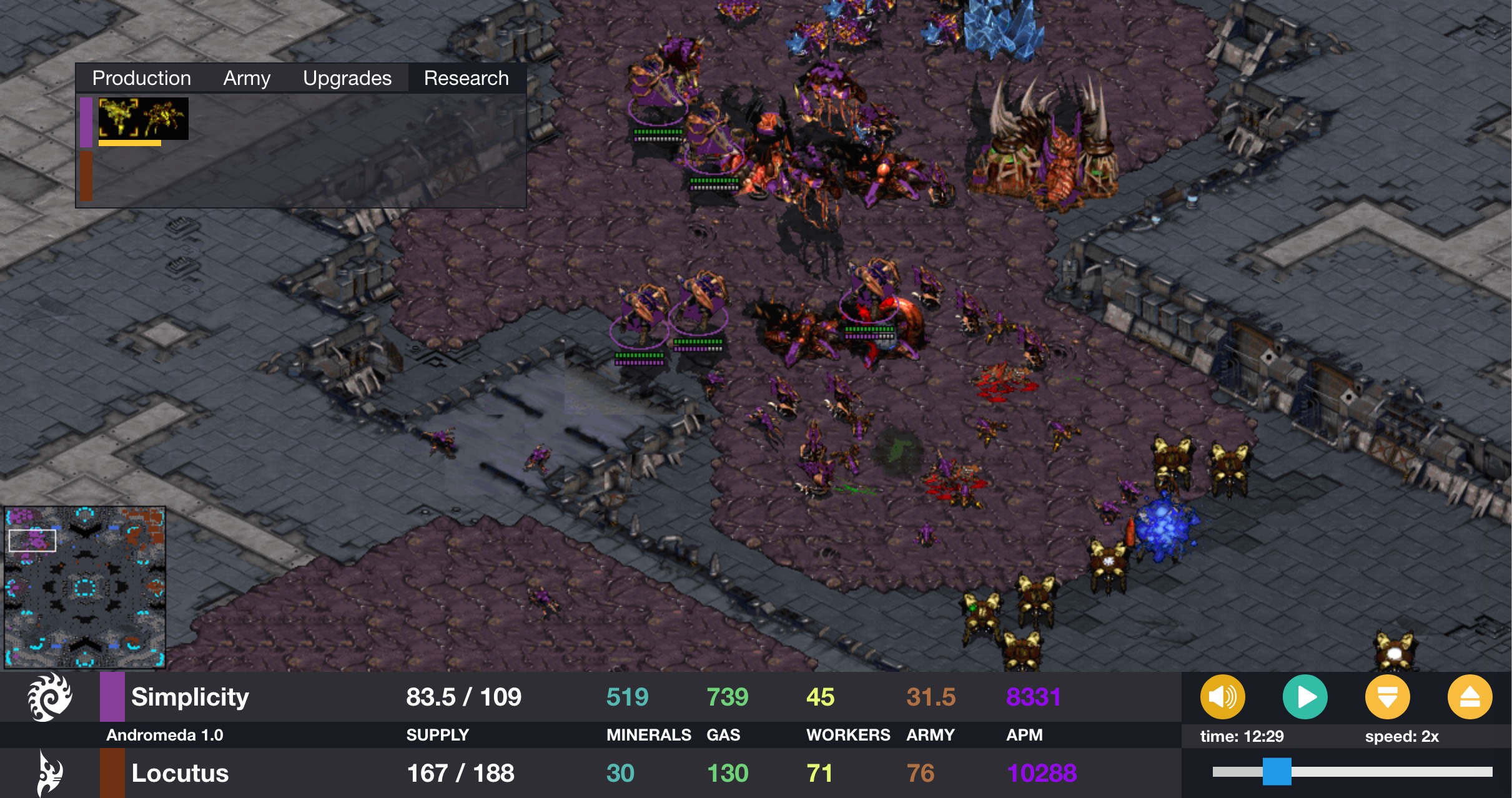
Yesterday’s game Simplicity vs Locutus on Andromeda on BASIL starts out as one of the most entertaining bot games I have seen. The pictures show some of the cool stuff that Simplicity tried—with success. Then, after a tremendous fight where each side pressed temporary advantages and maxed its army, the replay loses sync and OpenBW cannot show the last half of the game.

Queens with broodling. The Research tab shows broodling research, and there are broodlings on the ground. Simplicity made 8 queens early and even researched queen energy, and the queens paid for themselves with interest. When Locutus attacked, zerg sent out as many queens as had energy to simultaneously spawn broodlings, helping to break the attacks. It’s a simple way to coordinate the queens to get tactical results, and is more effective than the common bot approach of using the queens as attrition weapons. Simplicity’s queens eventually died to corsairs; with more careful play, they could have lived to the end of the game, because Locutus was not skilled with its corsairs.

Broodlings!

Island base with static defense. The overlord on the left has just dropped off another drone to join the miners.

Island!

Drops. Simplicity repeatedly dropped small numbers of units into the far end of Locutus’s base, and Locutus did not react properly. The drops were not decisive, but were cost-effective.

Drops!

Both sides maxed their supply, or nearly so. At that point, Locutus had better upgrades but Simplicity had a larger army. Locutus could not keep its natural safe. Luckily for protoss, it was already mined out.

Mass battles!

But Locutus had a stronger economy with more bases and a large bank of resources, and Simplicity ran out of resources. The desync hides the end of the game, which timed out after an hour. I believe that Locutus wiped out all zerg it could reach on the ground, and then had no answer for the island base. When the game timed out, BASIL gave the win to Simplicity on points. Moral: You need at least enough island skills to make air units to attack inaccessible bases.

Steamhammer can’t finish the game

Finishing off the enemy just means destroying all their buildings. It sounds simple, but it is a sophisticated skill, and there are a lot of ways to go wrong. Steamhammer has a number of special provisions for quickly finding the last enemy remnants, but small loopholes persist and occasionally a game slips through one.

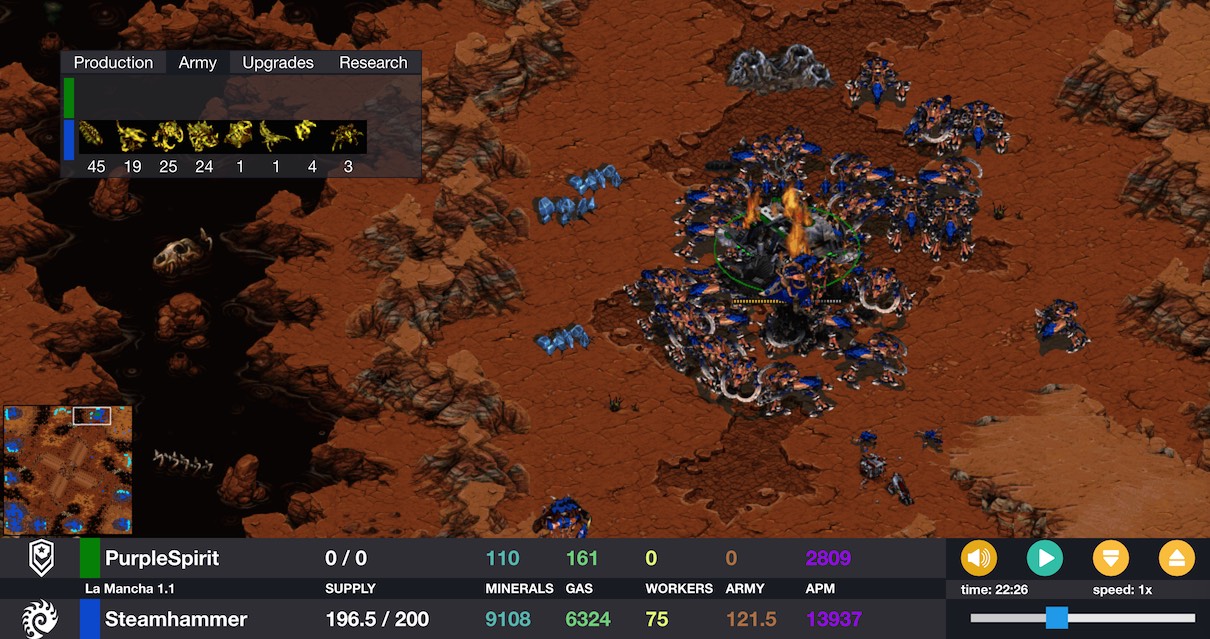
PurpleSpirit-Steamhammer on La Mancha is an example. It’s an entertaining game, thanks to the purple habit of playing all over the map, but I want to focus on the end, after PurpleSpirit has lost, when Steamhammer fails to destroy the floating terran buildings that are right over its head. That part is entertaining too, but not for the same reason.

the beginning of the end

Everything terran on the ground is destroyed, except one command center which was infested instead. The remaining terran force is 2 full-strength battlecruisers, and the remaining terran infrastructure is 2 floating ebays. Steamhammer is maxed and banking resources, but its only anti-air units are 8 scourge, plus a defiler with plague. Notice how much game time is left?

One of Steamhammer’s special game-finishing skills is that it makes mutalisks to chase down the residue of the enemy. The condition is, if the enemy has no known bases and no known anti-air units, then Steamhammer will tech to mutalisks and make mutas its primary unit. The mutas scout faster than ground units, and can find floating buildings and island bases that ground units can’t reach. But here terran still has battlecruisers, so the mutalisk rule does not kick in. First the terran army, such as it is, must be defeated.

swarm all over

Some scourge have hit, and the battlecruisers are no longer at full HP. But Steamhammer has been replacing losses primarily with more zerglings and ultralisks, which are of no use. Oops, the unit mix is wrong. Now there are only 2 scourge, and a battlecruiser can kill a scourge in one shot—2 battlecruisers, if not distracted by other targets, are safe from 2 scourge. The ebays choose to park over the terran natural, and zerg units have congregated there. The battlecruisers seek zerg stuff to shoot, and the defiler responds by blanketing the area in defensive swarm, consuming zerglings like crazy.

some damage has been done

Well, the 2 scourge hit one of the battlecruisers, which was distracted seeking zerg units that strayed from under dark swarm. And Steamhammer is now making 3 new pairs of scourge to replace various losses; if it can keep this up, the battlecruisers will eventually fall. Best of all, the defiler has plagued the terran buildings, despite the zerg units underneath. That will put the ebays into the yellow. One more plague should put them into the red, after which they will burn down.

nothing happens after this

Whew, finally the battlecruisers are shot down by scourge.

But that’s all she wrote. The swarms wore off and there was no need to renew them. The defiler did not plague again because it thought the zerg units underneath were more valuable. Scourge are coded to avoid floating buildings, because it is usually wasteful to spend gas destroying them. The mutalisk rule is engaged, and there is supply to build 1 mutalisk, but Steamhammer happened to choose to spawn zerglings first, and after that there was no supply to make a mutalisk. The game timed out with no more progress.

Finishing off the enemy can be hard. In this case, Steamhammer had the wrong unit mix; to make zerglings and ultralisks when all enemies were in the air was no good. The mutalisk rule should make mutalisks only, not mix them with other units. The scourge might have understood that when only floating buildings are left, they are good targets. Also the zerg ground units that can’t shoot up might have known better than to chase floating buildings (though it can be useful when they track a building trying to escape), and the defiler might have realized that damage to its own units was irrelevant when it could eliminate the enemy. That is a lot of flaws, and yet Steamhammer rarely fails to finish a game!

And fixing all the problems would only narrow the loophole, not eliminate it. In the worst case, Steamhammer would need to be able to destroy some of its own units to clear supply to make mutalisks to finish off the enemy. And that’s a high-end skill that I am in no hurry to add.

Next: The start of CoG 2019 analysis.

insanitybot can drop

The latest insanitybot update is able to carry out drops. The author seems to be systematically adding All The Features. Here’s a typical drop game, insanitybot-WillyT. Insanitybot plays a battlecruiser rush (compare PurpleSpirit’s battlecruiser rush), and follows up with a vulture drop.

I think insanitybot performs a drop in most of its games which go over 10 minutes. There are plenty more examples.

The drop feature is clearly leaning on the limited support for drop in insanitybot’s parent Steamhammer. The drop is a usually vulture drop, just like Steamhammer’s terran drop, and the dropship follows the same path around the edge of the map and unloads in the same location. Notable differences from Steamhammer’s drop skills are: 1. If there are no vultures, the dropship will carry marines instead. Are there other possibilities? 2. The drop is a middle game behavior, rather than being coded into the opening. 3. Insanitybot can lay mines, so spider mines may end up in the enemy base. I notice that the drop location near the mineral line is not ideal for laying mines, though. 4. Insanitybot attempts to set up for another drop. The dropship comes home after the drop, and sometimes picks up new units. If the dropship dies, another is eventually made. I have yet to see the second drop land, though.

The game insanitybot-Gaoyuan Chen is a highly effective marine drop. The dropship returns home and starts picking up fresh marines, but the marines are more interested in the fight in front of them than in the distant enemy base. The dropship is finally shot down before it can make the second drop.

Drop in the general case is of course a very complex set of skills. There are cliff drops (Icebot and SAIDA can drop tanks on a cliff), mixed unit drops (marines and medics are good), not filling the transport (to reduce the loss in case it is shot down, or to speed up the drop timing; it is normal for protoss to load only 2 dark templar into a shuttle, for example), multi-ship killing drops versus harassment drops, good play after dropping (lay mines in front of the enemy gateways, for example), changing the drop point based on new information (the dropship may fly over an unscouted enemy base), scanning the drop zone to make final plans (“ack, turn back, it’s well defended!” or “I only see zerglings, let’s go behind the minerals so we’re hard to reach”), and so on. Then there is coordinating the drop with other actions. In pro games, it’s common to escort the dropship across the map, load up near the destination, and carry the troops only a short distance. And there are tricks to draw forces away from the drop zone, or to use the drop to draw forces away from the front. It’s far more than any bot can do, for now. Another way to say it is, there are plenty of ways available to surprise your opponents in the next tournament.

What’s next for insanitybot? I think there are still some terran skills to add, but not that many!

insanitybot can nuke

I lost a lot of time dealing with a Pile of Irritating Life Events (PILE for short), but theoretically I should getting back to norbal (search for “everything is back to norbal”). We’ll see if theory holds. Expect a status update on Steamhammer before too long.

Insanitybot has been updated, and its description says “Nukes CAN be built and MAY be launched.” I thought that might be the plan. It looks like insanitybot-WillBot (random terran) on BASIL was its first nuke game, and the only one so far on SSCAIT or BASIL as I write. Unfortunately the replay desyncs toward the end, but there is a cataclysmic nuke launched at about 18:35. (BASIL, by the way, adds little icons on its recent games page to point out certain interesting types of games. That makes it easy to find nuke games.)

the nuke has been launched...

what’s that bright flash?

farewell, cruel world

The ghost’s cloaking energy looks low, but it was enough. In some cases WillBot scanned for cloaked ghosts and stopped nukes, but apparently this ghost stayed outside of range thanks to good nuke targeting. Don’t miss the before and after supply numbers.

Insanitybot also has a bug and builds multiple science facilities with covert ops. The bug may be in BOSS; that’s where I would look first. In Steamhammer, I intend to get rid of BOSS this year, so I’m not expecting to fix any BOSS bugs.

AIIDE 2018 - how CherryPi played

Overall, the play of the AIIDE 2018 CherryPi version looks similar to last year’s CherryPi which is still playing on SSCAIT. It still has the devastating ling micro, and it still prefers to win games with a flood of low-level units. It still gets melee +1 attack even when +1 carapace seems better. (Do CherryPi’s micro skills make +1 attack better, and if so, how?) Mutalisk micro looks very similar to Tscmoo’s, with mutas individually cautious and clever and collectively lazy and uncoordinated. It can use lurkers, guardians, and ultralisks. I didn’t see defilers, even when they would have been useful.

CherryPi scouts extremely aggressively with its first 2 overlords. They stick near the enemy base and try to poke into every corner, even if the enemy is terran and can shoot them down early. It gets a clear view, which must be useful for its build order switcher. The drawback is that the overlords often die young.

I think this CherryPi looks beatable. It doesn’t have SAIDA’s wide knowledge of action and reaction. It doesn’t have Steamhammer’s knowledge of how to react to LastOrder’s excessive static defense (but usually wins anyway with a zergling flood). It sometimes ignores undefended enemy bases, preferring to attack into the enemy’s strength—or even to wait idly. Game 31245 versus Iron shows it sticking with gas units and failing at macro; it forgot its love of zerglings. It doesn’t know whether it is ahead or behind, and it doesn’t realize that when it is maxed and owns the map, it ought to attack regardless of losses. It’s strong and tricky, but it also makes mistakes. I think next year’s version had better be improved if they don’t want to be overtaken.

Here are the names of the build orders that CherryPi recorded itself as playing in its opponent learning files. One of CherryPi’s major advertised features is a learned build order switcher that can switch to a new build order on the fly. It recorded 103 build order wins/losses for each opponent (except a couple with fewer), and 103 rounds were played, so these appear to be opening build orders only rather than all build orders tried throughout each game. Presumably the openings reflect CherryPi’s intentions when it started the game. It may not have followed the initial build order to its end.

  • 10hatchling
  • 2hatchmuta
  • 3basepoollings
  • 9poolspeedlingmuta
  • hydracheese
  • zve9poolspeed
  • zvp10hatch
  • zvp3hatchhydra
  • zvp6hatchhydra
  • zvpohydras
  • zvpomutas
  • zvt2baseguardian
  • zvt2baseultra
  • zvt3hatchlurker
  • zvtmacro
  • zvz12poolhydras
  • zvz9gas10pool
  • zvz9poolspeed
  • zvzoverpool

CherryPi tried between 1 and 4 openings against each opponent. CherryPi sometimes switched away from its initial try even if it won all games (for example, against CDBot and Hellbot), so I’m not sure what the switching criterion is. But opponents that it tried 4 openings against are all ones that gave it a touch of trouble.

grep -c key *.json

AILien.json:1
Aiur.json:1
Arrakhammer.json:1
BlueBlueSky.json:3
CDBot.json:2
CSE.json:4
CUNYBot.json:1
DaQin.json:1
Ecgberht.json:1
Hellbot.json:2
ISAMind.json:2
Iron.json:1
KillAll.json:2
LastOrder.json:3
LetaBot.json:4
Locutus.json:4
McRave.json:4
MetaBot.json:1
Microwave.json:3
SAIDA.json:4
Steamhammer.json:4
Tyr.json:1
UAlbertaBot.json:2
WillyT.json:1
Ximp.json:2
ZZZKBot.json:4

The other machine learning feature advertised for CherryPi is a building placer. It was trained against human building placements and apparently takes into account some of the bot’s intentions. I recommend against training on human play (or at least exclusively on human play), because machines play differently. Teaching a bot to blindly imitate human decisions that it doesn’t understand will lead to mistakes. It’s worse than teaching a human to imitate without understanding, because the bot won’t figure things out on its own. Nevertheless, CherryPi’s building placement does seem cleaner than other bots. To me the building placement looks simple and logical, but not sophisticated like a strong human player’s. Here’s an example from a ZvZ game, game 1755. The sunken colony does not interfere with gas mining, and it is somewhat protected from zergling surrounds by the geyser, the spawning pool, and the lair itself, while remaining open for drone drills on the drone side. The spire is curiously far away; I would have fit it into the gap next to the sunken. It looks OK but a little loose, not quite optimized. (By the way, game 14742 against the same opponent has the same building layout, except that the spire is placed close.)

ZvZ building placement in game 1755

CherryPi has gained new tactical tricks. I mentioned the burrow trick where it burrows zerglings at expansion locations. So far, I haven’t seen a game where the opponent was ready for the trick; I imagine it contributed to a lot of wins, even though CherryPi sometimes researches burrow and then never uses it. (And I’m disappointed. I thought of using this trick in Steamhammer, and didn’t because I expected that bots which knew how to clear spider mines would also know how to clear burrowed zerglings. I think I was wrong!) As far as I’ve seen, CherryPi doesn’t use burrow for any other purpose (though I wouldn’t be surprised, since there are so many). CherryPi also does zergling runbys; an example is game 1406 versus SAIDA where CherryPi played an unusual and not entirely efficient gas-first 3 hatch zergling build.

CherryPi doesn’t have as many complex skills as SAIDA, but it has a good number. I doubt I saw everything it can do.

AIIDE 2018 - how LastOrder played

The new bot #13 LastOrder is related to the classic Overkill by Sijia Xu, but uses a machine learning model to make certain decisions: According to the description, “all the production of unit (excluding overlord), building, upgrade, tech and trigger of attack.” The learning is entirely offline; LastOrder does not store information about its opponents between games. Tactical and micro decisions, and I think building placement, are decided by rule-based code. One survey answer says,

we train the proposed macro model against about 20 AIIDE 2017 bots on a 1000 machines cluster scheduled by Tournament manager. the final model achieve about 83% win rate on all AIIDE 2017 bots

Against the stronger AIIDE 2018 bots, LastOrder scored about 49%, good enough to land in the top half of the ranking. I think the 83% win rate is too high for LastOrder’s underlying strength; I suspect that it overfitted to its 20 opponents. I think it learned to recognize some of its training opponents by their play style, and when it sees similar signs from different bots that play differently, it reacts incorrectly to a game plan that the different bot does not follow.

I watched a bunch of games to see what kind of play LastOrder figured out for itself. LastOrder’s units are mutalisks and zerglings, sometimes with scourge; I did not see it make other units (though Overkill has hydralisk skills that it might have chosen). LastOrder’s game plan is to open safely with 9 pool, sit back for a while, watch the opponent, lay down massive static defenses when danger seems to loom, macro up lots of drones, zerglings, and mutalisks behind its ramparts, and eventually burst into action and overwhelm the opponent. Details vary, but the overall game plan seemed consistent in all the games I watched.

It’s not an objectively strong game plan, but it seems effective against many bots. LastOrder had trouble touching stronger bots, upsetting only Steamhammer, and was itself upset by Ecgberht and WillyT, which as terrans had no difficulty steamrolling static defenses. But it scored highly against most lower-ranked opponents, including LetaBot (which may have been on its panel of 20 with little change).

Game 39, LastOrder-Steamhammer (replay file), was a good example of the game plan. LastOrder countered zergling with zergling for a while, then seemed to grow bored and made 4 sunkens to hide behind—far more than necessary or useful. A little later, it seemed to predict Steamhammer’s spire timing, adding excessive spores too. Steamhammer understands in principle how to react: It makes extra drones and gets ahead in both army and economy. Steamhammer could not safely attack the heavy defenses, but it could prevent LastOrder from expanding beyond its natural and win slowly. Sure enough, LastOrder tried to expand to a third, Steamhammer caught it and sent the entire army to erase the attempt—and LastOrder exploited the play, which was strategically correct but tactically wrong, hitting Steamhammer’s natural while its forces were out of position. Steamhammer’s tactical analysis is minimal; it doesn’t realize that it should destroy the expansion attempt with a small detachment.

Game 33041, LastOrder-Tyr (replay file), is one of the games that makes me suspect that LastOrder overfitted. Watch what happens after 7:00. LastOrder scouts Tyr’s turtle cannons with a zergling. LastOrder immediately reacts by building... many spore colonies, a nonsensical action. I think LastOrder saw the cannons and concluded, “I’ve seen this play before, and I know what is coming: Carriers!” It believes it is playing against XIMP. It plays similarly in games against XIMP.

LastOrder is a super interesting experiment. It did not score high like CherryPi, but it applied reinforcement learning to a more difficult problem, and it is far more successful than Sijia Xu’s past experiments with machine learning in Overkill. Its middling result is worth something, and yet its play remains somewhat disappointing. LastOrder’s play is highly reactive, but the reactions are often poor and the bot’s range of play is narrow (a wider pool of training opponents should help). I didn’t give examples, but many games show dishearteningly weak macro and mistaken tech decisions (possibly a better training methodology is needed). The problem is not solved yet!

Killerbot-SAIDA games

I see that Killerbot by Marian Devecka has figured out its own way to beat SAIDA with its persistent mutalisk pressure: win 1 and win 2. I’m not sure how consistent it is, but as soon as SAIDA starts taking serious economic damage, terran only goes downhill. The update is a few days old now, and the most visible change is that Killerbot makes a few unupgraded hydralisks early, presumably only when the enemy has or is expected to get vultures. The hydras counter any early vulture or wraith tricks that terran might try. The idea is well known among human players, and Steamhammer uses it too.

I was looking at Steamhammer’s 2 hatch muta loss to SAIDA today, and thinking “With good muta micro and good decisions, zerg should win this.” I’ve been promising good muta micro for 2 years and haven’t delivered....

Update: Apparently SAIDA reacted by becoming more aggressive. It seems to have found an attack timing that works against Killerbot. Is this the same mechanism that solves rushes by adjusting timings, or a different kind of reaction? If it’s the same, the mechanism is quite general.

Steamhammer-Bereaver game with defiler

The game Steamhammer-Bereaver is a good example of Steamhammer’s defiler skills, both the good and bad points. Steamhammer gained an early advantage and contained Bereaver to its main, so the outcome of the game was not in doubt, hive tech or not. Bereaver mounted a strong defense at its ramp and held on for a long time. A timid zerg might have feared to attack and lost on points when the game time ran out—but of course Steamhammer is not timid.

The defiler dithered for a long time. Consume research finished at about 15:45 into the game, and the defiler filled up on energy within 15 seconds after, so that part was OK. A first attempt to break up the ramp was repelled with storm; the defiler was too far back and unable to help, due to lacking squad coordination. The second attempt to break up the ramp was at 18:20, and this time the defiler was in range. That’s about 2 and a half minutes from when the defiler was ready to act until it finally did; it had plenty of time in between to swarm or plague. It would have been worth it to sacrifice the defiler to plague the defenders.

swarm on the ramp

Excellent swarm placement! The defiler had energy to cast a second swarm farther into the enemy base, but did not. Even so, the one swarm nullified the dragoons and cannons and ensured that the attack would succeed if pressed. Thanks to my modifications, FAP understood that it would succeed and Steamhammer did press until it broke through. The attack had to be under way before the defiler could support it; Steamhammer has no ability to swarm (or plan to swarm) in advance of an attack. Steamhammer attacks when maxed, so in most winning games an eventual attack is guaranteed. When the swarm does come, it is generally well-positioned for where the units are at the moment, rather than where they are going or where they want to be.

The defiler seemed to get confused and did not contribute again until the very end, when it laid down a perfectly-placed plague over a few protoss buildings that were about to be destroyed anyway. The laser-precise plague hit as many protoss buildings as possible while missing zerg units. It’s impressive in a way, and it may even have shortened the game... by a fraction of a second.

Still next: Base defense.

Simplicity can do mass drops

Simplicity has been getting updates, and an update yesterday was apparently when it gained overlord drop skills. (There’s another update today.) It is the first zerg bot that I have seen use drops (well, in public at least). The drops look a bit stereotyped, with about 8 overlords loaded up in the main and sent (usually along the edge of the map) toward an enemy mineral line—it looks as though the drop happens when the overlords find targets to drop on. That makes Simplicity the first bot I have seen do mass drops, a unique skill.

I found 3 drop games on SSCAIT. Curiously, all 3 games are on Moon Glaive, although Simplicity does research drop on other maps. The less impressive games are Simplicity-Juno aka Yuanheng Zhu and Simplicity-NiteKat terran. Drops definitely did not change the outcome of those games. The best drop game is Simplicity-WillBot, in which WillBot randomed to terran.

The first drop started to load up at the zerg main just before 16:00 into the game—while a terran attack on the natural was underway, not the most auspicious time. Apparently Simplicity does not put much analysis into the drop decision. In the picture, the two players are roughly even (objectively, with no defilers in sight, the big terran army should win, but neither bot has the skills). The selected overlords are exactly those that are loading units. In the minimap, notice the long tail of terran units moving toward the zerg natural; the terran attack was kind of piecemeal.

overlords load up

Loading proceeded slowly, I guess since the ground units were distracted by the terran activity, and the overlords set out at about 16:40. The overlords proceeded counterclockwise around the edge of the map toward the terran main. Meanwhile, terran diverted to annihilate the zerg base at 9 o’clock before returning its attention to the zerg natural, and zerg units that were still on the ground bypassed the marines and tanks and headed for the terran natural to counter. Simplicity’s decision was good. Attacking the terran bases from both sides put WillBot into a difficult situation where it was tough to make the right choices.

The drop started to land at about 17:40. WillBot defended the ground maneuvers poorly; it left tanks forward to pressure the zerg, and lost them to zerglings, and sent marines back to defend, where they ran full tilt into burrowed lurkers. In the picture, notice that both sides have lost workers and WillBot has already fallen behind before the drop happened. The white dots in the terran natural are lurkers which are in range of the command center.

overlords drop units

WillBot did finally clear the attack, but was far behind. Simplicity made 2 follow-up drops to finish off the terran main.

All in all, the mass drop skill could use improvement—but you could say that about almost any skill of any player. In Steamhammer, I have held off on zerg drop because I think it requires tactical analysis that the bot can’t do yet. In this game we see that mass drop can be a scary ability even with little tactical calculation behind it.

Proxy-Tyr game

I thought that Proxy versus Tyr by Simon Prins was a good game to draw lessons from. It’s strategically simple and has a clear turning point.

Tyr played a Giant Terran Death Ball Will Crush You strategy, macroing up a juggernaut of tanks and marines before moving out. That gave Proxy time to do its thing and develop a roaring economy, in the meantime frittering away a few units in light harassment. Proxy went with a lurker-ling mix. When Tyr moved out, Proxy attacked repeatedly to little avail, looking almost helpless in the face of terran might. Zerg slowed the terran force but could not harm it much, fighting inefficiently and losing units at a high rate. Then suddenly the terran ball unraveled and the game was all Proxy. What happened?

Lesson 1. When Tyr’s force reached the bridges to the enemy natural, it became disorganized trying to move through the narrow choke. That’s the main reason the game was lost. At the same time, Proxy’s forces, trying to approach from all angles, concentrated their attack more effectively. I suppose that’s partly due to the map configuration and mostly due to Proxy realizing that it could attack the disorganized terrans with advantage.

The lesson is that movement is a big deal. Moving units around the map is important and difficult in itself. Bots struggle with moving around in good formation, and in difficult terrain they have no idea how to adapt. For the first micro skill that I implement with machine learning, I am seriously considering the skill of moving squads from place to place.

Lesson 2. Don’t waste units–well, it’s empty advice, everybody knows that. But look how many units Proxy lost needlessly before the decisive engagement. It could afford the losses because of its strong economy and strong macro, and fighting when it did was not wrong, because it slowed the terran down. But if Proxy had fought efficiently, the terran ball would have been broken in the middle of the map, not perilously near the zerg natural. Steamhammer desperately needs to learn this lesson.

More a suggestion than a lesson. I think terran did not take full advantage of the situation, and I don’t mean only neglecting to get stim. Leaving aside the need for terran to take a third itself, when zerg spreads to a large number of bases, terran should be thinking “how can zerg defend all that?” In this game, Proxy went all ground with no air defense. If I were the terran, I would have made a couple dropships: Drop marines and medics off to one side, stim, run in and eradicate drones, then focus on the hatchery. When defenders appear, fight them if you like, or else pick up and drop another base. If zerg invests in defending the many bases, the cost will be far more than you spent to harass them. The terran ball will be a little weaker, or will move out later, but zerg will be substantially weaker.